
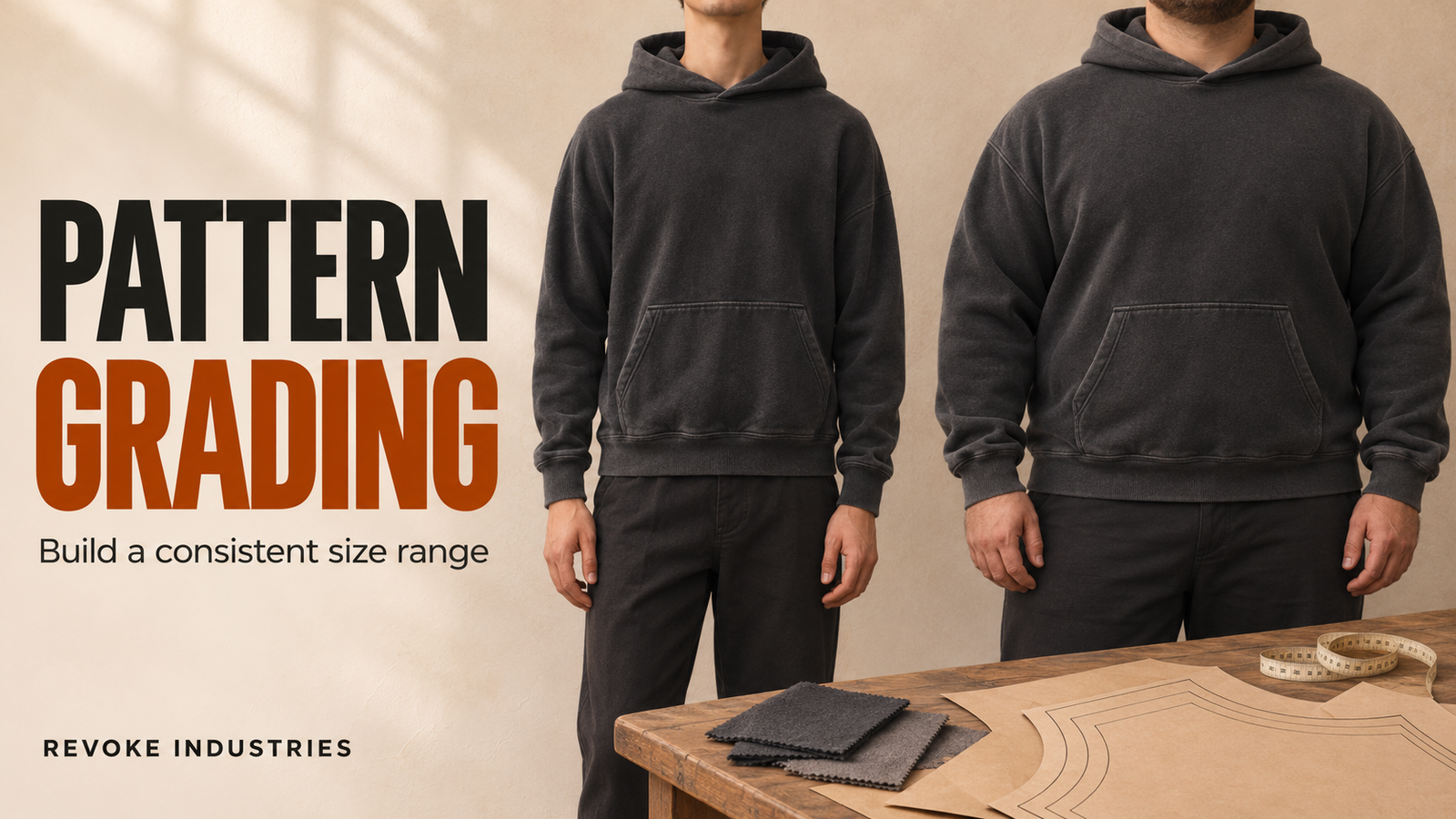
Imagine approving a relaxed hoodie in medium. The chest feels right, the shoulder sits where you want it and the sleeves finish at the wrist. When the larger sample arrives, the body is wider, but the neckline feels too open and the pocket looks misplaced.
The problem cannot be explained by chest width alone. Your brand needs a size-development plan that considers the garment as a whole. This guide explains pattern grading, the information to give a manufacturer and the checks to make before approving a production size range.
What does pattern grading change?
Pattern grading creates additional sizes from a base pattern using a size specification or grading increments. The National Instructional Media Institute's fashion-design training material describes this process as developing smaller or larger sizes while retaining the garment's original design.
For a brand, the practical goal is to preserve the intended style and fit relationship across the planned sizes. Width, length and other dimensions need deliberate decisions; enlarging a drawing by one percentage is not a complete grading brief.
Grading also needs a sound starting point. Resolve the base-size fit before using it as the reference for the rest of the range.
Pattern making, grading and size charts: what is the difference?
These terms describe related work, but each produces a different reference for the project. The Fashion Institute of Technology's grading guide distinguishes developing a production size range from the initial patternmaking and sample work.
| Item | What it defines | What the buyer should confirm |
|---|---|---|
| Base pattern | The garment's starting shape and construction | Which pattern revision matches the approved fit |
| Graded patterns | Pattern pieces for the planned sizes | Their relationship to the agreed size specifications |
| Garment measurement chart | Target dimensions of the finished clothing | Units, measuring methods, sizes and tolerances |
| Customer size chart | Information shoppers use to select a size | Whether figures describe the body or the garment |
A customer-facing chart does not replace the manufacturing specification. Our clothing size chart guide explains that distinction and how to document measurement methods.
Are there universal pattern grading standards?
Do not assume that one set of increments suits every product. Techpacker's explanation of grade-rule libraries notes that rules vary with design features, fabric properties and the type of grade. A knit garment and a woven garment may therefore need different development decisions.
When discussing pattern grading standards in the fashion industry, make the reference specific: which customer group, size system, garment category and fit are you developing? The Kerala SCERT fashion and apparel textbook describes grade rules as being developed with the intended market segment in view.
“Use US sizes” leaves important decisions open. Give your manufacturer the selected sizing reference, intended customer measurements and product fit brief. Agree how those inputs translate into the finished garment rather than treating a size label as a complete specification.
For extended ranges, ask the pattern team whether different increments, additional fit reviews or another base block are appropriate. Confirm the approach before extending an existing chart.
Start with an approved base size and a defined range
Before grading begins, record what has actually been approved. A useful starting brief contains:
- The style code and current pattern revision.
- The base size and its approved sample reference.
- The intended customer and fit, including any underlayer allowance.
- The planned sizes and any separate size groups.
- Identified fabric, finishes and components.
- A measurement specification with clear point-of-measure instructions.
If your fit reference is described as boxy, oversized or athletic, explain it through the product's measurements and proportions. Our boxy vs oversized hoodie guide shows why a silhouette label needs more detail.
Ask the manufacturer which starting sizes and sample coverage it recommends for the project. The coverage plan should identify what will be physically checked and what remains untested.
Grade increments and tolerances answer different questions
A grade increment is the intended change between sizes. A measurement tolerance is the permitted variation around a size's target. Keep both visible in the specification so a manufacturing allowance is not mistaken for a size-development instruction.
Here is a simplified, hypothetical chart for three finished-garment measurements. The figures are illustrative inches, not industry standards or a Revoke product specification.
| Finished measurement | S | M: base size | L |
|---|---|---|---|
| Chest width, laid flat | 21 | 22 | 23 |
| Body length, high shoulder point to hem | 27 | 27.5 | 28 |
| Sleeve length, shoulder seam to cuff | 24 | 24.25 | 24.5 |
In this example, the M-to-L changes are 1 inch at flat chest width, 0.5 inch at body length and 0.25 inch at sleeve length. Each point has its own progression.
Label a flat width clearly; it is a different measurement from a full circumference. Also show where each measurement begins and ends. “Sleeve length” could otherwise be interpreted from the shoulder seam or from another reference point.
The chart shows finished-garment targets. The pattern team still needs to distribute changes across the relevant pattern pieces and check their relationships. Add agreed tolerances separately for the actual product; the example does not prescribe them.
How are patterns graded manually or digitally?
The NIMI training material recognizes both manual and computerized grading. Common approaches include cutting and spreading or overlapping pattern sections, shifting a pattern through defined movements, and applying rules through apparel CAD software.
For a buyer, the useful question is how the result will be checked and handed over. Ask which files, size specifications and samples the supplier will provide, and who is responsible for updating them after a fit correction.
A digital file is one part of that approval record. It still needs the correct base pattern, intended grade rules and review of the resulting sizes.
Review a size set before accepting the graded range
A size-set review gives the team physical garments in agreed sizes to assess alongside the specifications. Agree whether the submission covers every size or selected sizes, and document any gaps. Base-size approval alone does not provide that evidence.
Review the samples in a consistent condition, using the agreed measuring method. Techpacker's QA size-set workflow compares actual measurements with size targets and upper and lower tolerances. That comparison is useful, but it should sit alongside a fit review.
For each submitted size, check:
- Measurements: record actual values against the current specification.
- Proportions: review width, length, shoulder position and sleeve balance together.
- Wear and movement: assess the intended fit on an appropriate wearer or form where practical.
- Construction relationships: inspect armholes, necklines, openings, cuffs and hems.
- Placement: check pockets, artwork and labels against the agreed references.
- Decision: record what is approved, what needs correction and which sizes need rechecking.
If an XL sleeve changes, ask the pattern team whether related sizes or joining pieces need review. Update the size specification and pattern revision together, then identify the evidence needed to close the correction.
Keep fabric behavior separate from the grade plan
The chosen material and processing route also affect the finished garment. Cotton Incorporated's guide to improved shrinkage performance identifies fabric construction, processing, finishing, apparel manufacturing and care among the factors affecting shrinkage.
Agree when measurements will be assessed: before a specified wash, after finishing, or after an agreed care test. Record the method and compare like with like.
A pattern adjustment for observed shrinkage and an increment between sizes address different needs. Ask the supplier to explain both, using trials on the intended material. Avoid applying an assumed percentage to the whole range without supporting sample evidence.
What should you send your manufacturer?
Use this checklist to connect the product brief with the grading and approval work. A hoodie tech pack or T-shirt tech pack can hold the relevant references.
| Brief section | Include or confirm |
|---|---|
| Starting point | Approved base-size sample, style code and pattern revision |
| Size plan | Intended customer, size labels, range and agreed sizing reference |
| Measurements | Target values, units, POM instructions and separate tolerances |
| Materials | Fabric identification, finish, components and assessment conditions |
| Sample coverage | Sizes to submit, quantities and required measurement or fit evidence |
| Handover | Final graded chart, pattern file scope, revisions and approval record |
If editable patterns are part of the project, agree their format, contents, delivery and permitted use in writing. Ask whether development, grading and additional sample rounds are included in the manufacturing quote.
Finally, distinguish size-range approval from permission to begin the whole bulk order. Connect the grading record to your pre-production sample approval so outstanding material, construction or decoration decisions remain visible.
Frequently asked questions
Is pattern grading the same as pattern making?
Pattern making develops the garment's initial shape and construction. Grading develops additional sizes from the base pattern using defined changes. Confirm which work your supplier includes in the development scope.
Can every measurement increase by the same amount?
Do not assume so. Chest width, body length, sleeve length and neckline dimensions need their own decisions. Set the progression around the intended customer, style and material, then check the resulting garments.
Is a graded measurement chart enough to approve the fit?
It defines targets, but it does not show how every physical garment sits or moves. Agree a size-set and fit-review plan, and document the sizes and conditions actually assessed.
Can the same grade rules be used for every fabric?
They should be reviewed for the product. Stretch, construction, finish and intended fit may change the development requirements. Ask the pattern team to evaluate a material change before reusing an approved grade plan.
What happens if the base-size sample changes?
Identify the new pattern and specification revision, then ask which graded sizes and related pieces need updating. Recheck affected samples as agreed before treating the range as approved.
Develop your size range with Revoke Industries
Revoke Industries offers custom apparel and OEM/ODM development in Sialkot, Pakistan. Share your design, approved sample status, measurement chart, fabric preferences and intended size range.
The next step is to confirm the pattern-development scope, grading requirements and sampling plan for your collection.
Sources and further reading
- NIMI: Introduction to Pattern Grading.
- Fashion Institute of Technology: Grading, Sizing and Standards.
- Kerala SCERT: Fashion and Apparel Designing, section 3.2.15.
- Techpacker: Pattern Grading in the Fashion/Garment Industry and QA Size-Set Template.
- Cotton Incorporated: Guide to Improved Shrinkage Performance of Cotton Fabrics.



Add comment