

Your clothing sample arrives. The fabric feels right, the logo looks sharp, and you are ready to tell the manufacturer to start production.
Before you send “approved,” make sure both sides understand exactly what that word covers. Are you approving the fit, the artwork, or the complete garment in its final materials?
For a US clothing brand working with an overseas manufacturer, a clear pre-production sample approval record gives the team a shared reference when you cannot review every detail together in person.
Pre-production sample approval is the documented acceptance of a garment intended to represent the bulk order. Review it against the current specifications, identify unresolved differences, and record the approved sample and document versions. Make the permission to start bulk production explicit.
What is a pre-production sample?
A pre-production sample, often called a PP sample or PPS, is used to check the final garment before bulk manufacturing. It should represent the intended production fabric, trims, construction, measurements, and decoration.
Techpacker’s guide to garment samples distinguishes this stage from earlier development and fit samples. Confirm your supplier’s terminology and what each sample is intended to prove.
| Sample stage | Main review purpose |
|---|---|
| Development or proto | Review the design interpretation. Some materials may be substitutes. |
| Fit sample | Evaluate shape, measurements, and how the garment sits on the wearer. |
| Size set | Check how the approved fit translates across the selected sizes. |
| Pre-production | Review the intended finished product before authorizing the bulk run. |
| Top of production | Compare garments taken from production with the approved reference. |
Agree on the checkpoints your order needs. A sample sent for photography does not automatically provide evidence that all production requirements have been checked.
1. Identify the sample before inspecting it
Assign the physical sample an identifier and record its style code, size, color, sample round, and received date. Match it to a dated tech pack and artwork version.
Ask the manufacturer to list substitutions: temporary fabric, a different zipper, missing labels, or decoration that is only a placement mockup. Keep those exceptions visible in the review.
For example, a sample made with substitute rib can help you discuss sleeve proportions, but it leaves the final cuff material unresolved. Record the open item and the evidence needed to close it.
If your specification is still incomplete, start with our hoodie tech pack guide. Approvals are easier to manage when the requested details already have a clear written reference.
2. Check measurements and fit separately
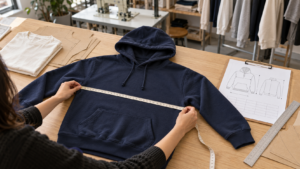
Use the same measurement methods and units shown in your specification. Record each target, the sample’s actual measurement, and the agreed tolerance. Photograph the tape position when a measurement needs explanation.
Then review the garment on a wearer appropriate for your intended fit. Ask them to stand naturally, reach forward, raise their arms, and sit where relevant. Note what changes during movement.
A measurement can meet the chart while the silhouette still needs adjustment. If you change the desired fit, update the target specification; do not describe an intentional design change as a factory measurement error.
Illustrative example: Your specification lists a 23-inch flat chest with an agreed tolerance of ±0.25 inch. The acceptable measurement range for that point is 22.75–23.25 inches. A 23.5-inch sample is outside that range. These numbers demonstrate the review method; they are not universal sizing or Revoke Industries’ production tolerances.
Check the size range as agreed, rather than assuming that one approved medium proves every size. Our clothing size chart guide explains measurement methods, grading, and fit checks.
3. Review the complete garment, including unresolved details
Use a checklist that links each decision to evidence. The following is a suggested review worksheet; adapt it to the product and your agreed specification.
| Review area | What to record |
|---|---|
| Fabric and color | Material reference, approved color standard, finish, and any unresolved substitution. |
| Measurements and fit | Completed measurement sheet, fit observations, and sizes reviewed. |
| Construction | Seam and hem appearance, collar or cuff details, and agreed corrections. |
| Decoration | Artwork version, dimensions, placement references, colors, and appearance. |
| Trims and labels | Component references, attachment positions, approved label artwork, and function checks. |
| Care performance | Test conditions, before-and-after observations, results, and acceptance criteria. |
| Packing | Agreed folding, individual packaging, size identification, and carton instructions. |
For decoration, write “move the graphic down 0.5 inch from its current approved reference point” only when that reference is defined. A marked drawing with the final placement dimension is easier to reuse than a message saying “slightly lower.”
Inspect visible details, but request supporting evidence for specifications you cannot establish by touch or appearance alone. For hoodie-specific inspection points, see our custom hoodie sample checklist.
4. Review what happens after washing
A sample review should consider the product after care as well as when it first arrives. CottonWorks explains that dimensional stability depends on factors including fabric construction, processing, finishing, garment manufacturing, and care.
Agree on the relevant wash and dry conditions, number of cycles, measurement procedure, and acceptance limits. Record the conditions alongside results so that two different wash routines are not treated as equivalent tests.
Compare measurements before and after the agreed procedure. Also record changes in garment shape, seam position, neckline appearance, and decoration. Ask for appropriate testing support when the product requirements go beyond your own review capability.
Keep the washed sample identified separately from the unwashed reference. Do not adopt a single shrinkage percentage for every fabric and product without discussing whether it meets the intended fit and performance requirements.
5. Send one consolidated correction sheet
Put all comments for a sample round in one document. Give each issue a reference number, attach a clear image, describe the required result, and state how the correction will be checked.
Use the same identifiers in your email and tech pack. If two team members disagree about the sleeve length, resolve the decision internally before sending contradictory instructions to the manufacturer.
Style / sample ID: [Insert]
Size / color: [Insert]
Tech pack / artwork version: [Insert]
Decision: Revise and resubmit; bulk production is not authorized.
Issue 01: [Observed difference and photo reference]
Required result: [Final measurement, construction detail, or approved reference]
Verification: [Revised physical sample, measurement report, or other agreed evidence]
Unresolved materials or details: [List]
Next step: Please confirm these corrections, any cost or schedule changes, and the expected resubmission date.
This template is a suggested communication format. Replace every placeholder and agree on the review process with your supplier.
6. Make the production release explicit
Avoid leaving “approved with comments” unexplained. If there are corrections, identify which activities may proceed, which remain on hold, and who will verify the changes.
For a straightforward workflow, hold the bulk release until unresolved product requirements are closed. If you choose a staged release, document its scope rather than assuming the factory will infer it.
Your final approval should identify the sample, style, color, applicable sizes, tech pack version, artwork version, date, and approver. State the order covered by the release. Keep an identifiable reference sample with both teams where practical.
Also confirm the schedule after approval. Sample acceptance, material readiness, payment milestones, and a reserved production slot may be separate conditions in your agreement. Our clothing manufacturing timeline guide helps you plan those dependencies.
Does sample approval replace bulk quality checks?
No. The approved sample provides a comparison point; it does not demonstrate that every bulk garment matches it. Agree on checks during production and before shipment, including who performs them and how findings are resolved.
Save the final specifications and approval record together. If a later change affects fabric, fit, construction, or decoration, identify what needs reviewing again before that change enters production.
Frequently asked questions
Can I approve a clothing sample from photos?
Photos can support checks of visible details and corrections. They leave limitations around feel, fit, movement, and physical performance. Agree on which decisions require a physical sample and which can use other evidence.
How many sample rounds should I plan for?
There is no fixed number suitable for every order. Discuss product complexity, unresolved materials, review stages, revision fees, and courier time before sampling starts. Build the schedule around the agreed work.
Should every color have a separate sample approval?
Define what each approval covers. One color does not establish every other color’s appearance or decoration result. Agree on the physical samples, swatches, decoration tests, or reports needed for each variation.
What should I do if the sample does not match my tech pack?
Identify the exact difference, check that both teams used the same document version, and send a consolidated correction sheet. Request the agreed evidence of correction before releasing the affected work.
Can I change the design after approving the sample?
You can request a change, but confirm its effects on cost, timing, materials, and work already completed. Issue a revised specification and agree on any new sample review before authorizing the change.
Prepare your next sample request
Send Revoke Industries your tech pack or design references, product type, intended size range, fabric requirements, and target quantity. Include the decisions you still need to resolve so the sampling scope can be discussed clearly.
Further reading: Techpacker: types of garment samples; CottonWorks: shrinkage and skewing. The worksheets and example approval workflow above are practical editorial suggestions, not a statement of Revoke Industries’ order terms.


Add comment