
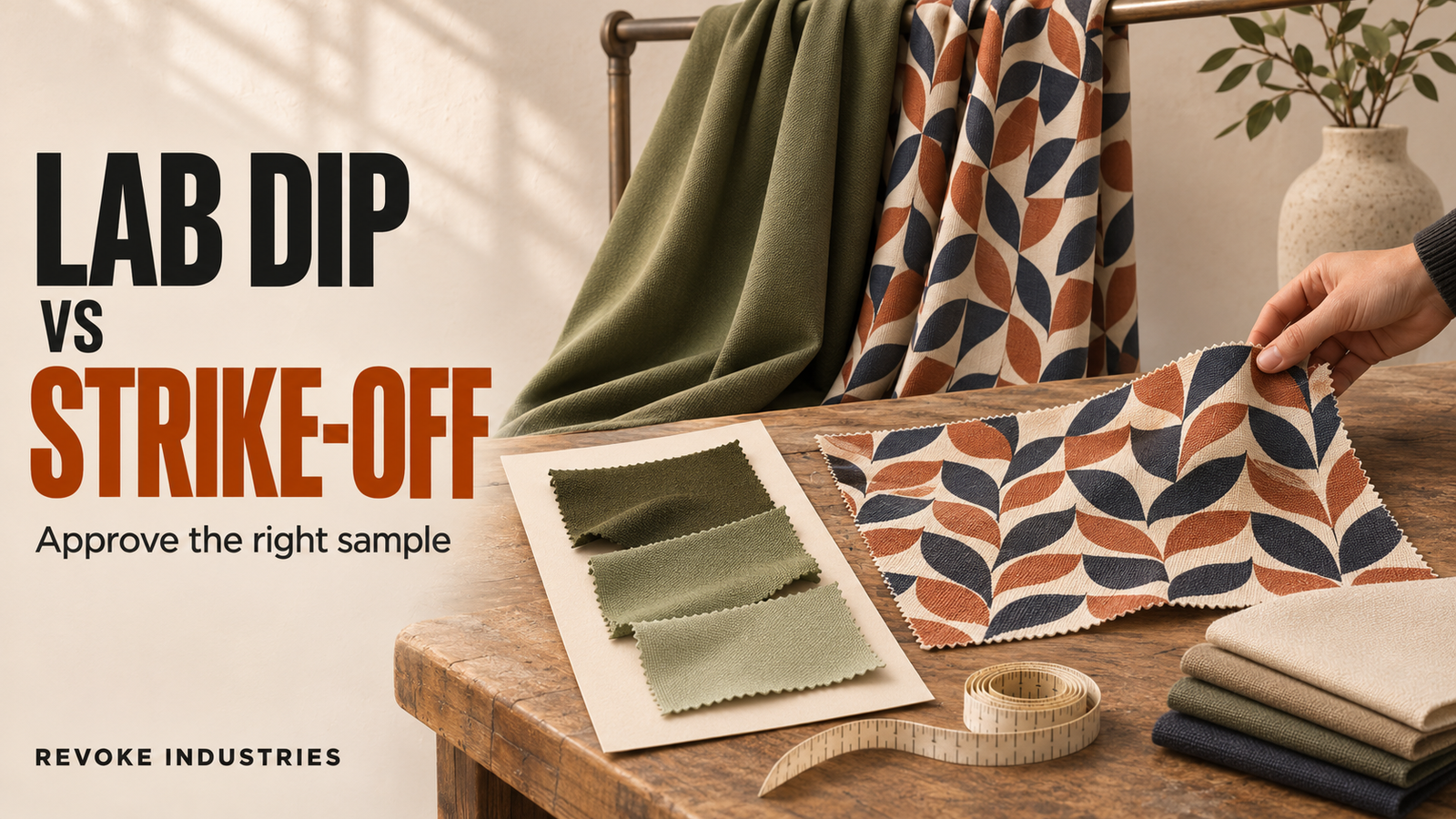
You are developing an olive hoodie with a cream chest graphic. The supplier sends a dyed fabric swatch, and the olive looks right. Does approving it also approve the cream print, its size or how it feels on the hoodie?
Those are separate decisions. For a clothing brand, choosing the right submission helps keep color development, artwork approval and final sampling connected. This guide explains which sample to request, what to check on a print trial and how to record the next step clearly.
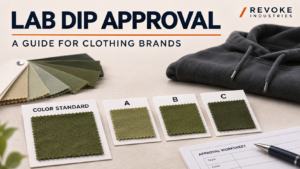
What is the difference between a lab dip and a strike-off?
The difference is the process being evaluated. A lab dip concerns dyed color on an identified material. A print strike-off concerns artwork produced through an identified printing process.
The International Trade Centre's Garment Costing Guide distinguishes lab-dip submissions for solid goods from strike-offs for patterned goods. This is a useful starting point; the supplier still needs to confirm the exact material, process and approval scope for your project.
| Decision | Lab dip | Print strike-off |
|---|---|---|
| Main purpose | Review a developed dye shade | Review the result of printed artwork |
| Reference needed | Identifiable color standard and material | Current artwork, color references, material and print method |
| Main buyer question | Is this the intended dyed shade? | Does this artwork print as intended on this material? |
| Later checks | Actual production shade and finished garment | Production print consistency and finished garment |
Terminology matters. CottonWorks also uses strike-off for a woven head-end sample. This article uses print strike-off specifically. State the process in your request instead of relying on the sample name alone.
Which sample should your clothing brand request?
Start with what must be developed or confirmed. A ready-made stock fabric, custom dye shade and new print design do not necessarily require the same approval route.
| Your project | Submission to discuss with the supplier |
|---|---|
| A new solid dye color | Lab dip on the specified material |
| An existing stock fabric shade | Current stock or batch swatch; confirm whether new color development is needed |
| A new all-over printed design | Print strike-off using the intended artwork, fabric and process |
| A custom-dyed garment with a printed logo | Dyed-color approval plus a print trial on the agreed ground material |
| An embroidered logo | An embroidery sample or sew-out, with the scope agreed separately |
For the full dyed-color workflow, use our lab dip approval guide. For a printed polyester garment, the cut-and-sew sublimation guide explains how artwork approval also connects with panel construction.
Why is a digital mockup not the same as a print trial?
A mockup communicates the design concept. It can show where a graphic belongs and how a collection should look. It does not reproduce the actual fabric surface or printing conditions.
Spoonflower's color guidance explains that fabric weight, weave and base color can affect printing results. It also distinguishes the screen appearance from the printed sample. Its specific color workflow belongs to its own service, so ask your supplier for the requirements of the process being quoted.
If a brand color is important, identify its agreed reference. If motif size is important, provide dimensions and units. “Match the screenshot” leaves both the visual target and the method of comparison unclear.
What should you check on a print strike-off?
Request enough printed material to evaluate the decisions you are being asked to approve. A small crop of a large design may leave layout or repeat questions unresolved.
DXL Group's published 2022 development manual illustrates a buyer-defined process: its all-over print submissions identify the method and fabric construction, while review includes ground color, pattern colors, layout and registration. Those are that buyer's documented requirements, rather than universal sample dimensions or deadlines.
For your project, agree a practical review covering:
- Submission identity. Match the sample to the current style, artwork revision, fabric code and colorway.
- Ground and printed colors. Compare the intended combination, including any unprinted areas.
- Scale and direction. Check motif dimensions, orientation and any directional graphics against the brief.
- Repeat or layout. Look for unintended gaps, lines, cropping or changes where the design repeats.
- Detail. Review lettering, fine lines and boundaries between colors at the intended print size.
- Surface and handling. Assess the feel and appearance relevant to the garment; record any finish still pending.
Spoonflower's proofing guidance separates scale and repeat settings from physical proofing of color, scale and layout. For a custom manufacturing project, use your supplier's templates and evaluation plan rather than copying another service's file settings.
A fabric trial also needs an appropriate follow-up. A chest print should be reviewed on the finished garment for its agreed placement. An all-over panel design needs assembled-sample review at seams. A flat swatch cannot show the complete garment relationship.
Can one garment need both a lab dip and a strike-off?
Yes. Consider the hypothetical olive hoodie with a cream graphic. The body shade and the printed graphic need separate references, even though the buyer will eventually judge them together.
A useful plan could be:
- Identify the dyed body fabric and color reference.
- Review the dye submission for that stated color scope.
- Review a print trial on the agreed ground material using the named artwork revision.
- Assess the combination on the finished sample.
- Record any bulk-material, print-performance or other approvals still required.
Confirm the sequence with the manufacturer. Some development tasks may run in parallel, while the final print trial may depend on the approved ground. If that ground changes, ask whether the existing print approval remains representative.
Keep these references in the hoodie tech pack or the relevant garment's technical file.
How should color be evaluated across materials and lighting?
Review the intended combination under agreed conditions. The dyed fabric, printed graphic and visible trims may use different materials or coloring systems.
Datacolor explains metamerism as a situation where samples appear to match under one lighting condition but differ under another. Its guidance combines controlled visual assessment with appropriate measurement where required.
Agree which standards, viewing conditions and measurement criteria apply to the project. Phone photos can identify a submission and help explain a concern; they should not silently replace the agreed color-critical approval method. Our lab dip guide covers color evaluation in more detail.
Does an approved strike-off prove wash performance?
Appearance approval and performance evidence answer different questions. A print may look acceptable when received, while the intended care conditions still require evaluation.
Intertek's colorfastness guidance distinguishes resistance to color change or transfer under exposures such as washing, rubbing, light and perspiration. Agree which evaluations matter for the product, along with the methods, sample condition and acceptance criteria.
Record whether the submitted print has completed its proposed processing and whether any required test results are available. The appearance sign-off should identify any open performance decision rather than implying that all requirements have passed.
How do you write a useful approval or revision comment?
Make the decision traceable to the exact submission. State the accepted scope, the problem if one remains, and the action the supplier should take.
| Approval record | Information to retain |
|---|---|
| Project identity | Style code, supplier and relevant order or development reference |
| Submission | Sample ID, round, date, material code and print method |
| Design references | Artwork filename/revision, colorway and agreed color standards |
| Review scope | Color, scale, layout, feel or other specifically assessed items |
| Decision and next step | Approved scope or required correction, owner and next checkpoint |
Here is a fictional revision comment for the hoodie example:
Revision required — HD-04 / PRINT-02 / artwork v3. The cream graphic measures 24 cm wide; our current brief specifies 22 cm. Please revise the scale and identify the new submission. The body-fabric color decision remains separate. Print approval is pending.
The dimensions illustrate how to describe a discrepancy; they are not a recommended logo size. In a real approval, retain the sample and the measurement or visual evidence supporting the decision.
What still needs checking before bulk production?
Keep the development references connected to actual production material. Confirm how the supplier will check the bulk shade or printed output and what changes would require another review.
Also review the finished garment, including fit, components, decoration placement and any intended washing or finishing. Link the accepted submissions to the pre-production sample approval so the team can see which decisions are complete and who may authorize the next stage.
When requesting a manufacturing quote, ask whether dye development, print trials, revisions, courier shipments and required testing are included. Have the manufacturer identify their effect on the schedule for your specific project.
Frequently asked questions
Is a strike-off the same as a lab dip?
A print strike-off evaluates printed artwork on fabric. A lab dip develops a dye shade on an identified material. Confirm the terminology with the supplier because strike-off can also refer to a woven trial.
Do I need both for a printed T-shirt?
It depends on the project. A new custom-dyed ground and a new print may need separate submissions. If the fabric is an existing stock shade, ask which material reference and print trial are appropriate.
Can I approve a strike-off from a photograph?
A photo can help discuss layout or identify the sample. For color-critical approval, follow the agreed physical or controlled digital evaluation method. A phone image alone does not reproduce the fabric's actual appearance or feel.
Does print approval confirm placement on the garment?
Only within the stated scope. A fabric trial can show the printed result, but final placement and the relationship to seams or panels need the appropriate garment reference or assembled sample.
What if the fabric changes after approval?
Ask the supplier to reassess the approval. Identify the new material, ground and processing route, then agree what must be resubmitted before relying on the earlier reference.
Plan your color and print approvals with Revoke Industries
Revoke Industries provides private label and OEM/ODM apparel manufacturing from Sialkot, Pakistan. Share your garment design, fabric requirements, color references, artwork status, quantities and destination.
Ask the team to confirm the color-development, print-trial and finished-sample stages appropriate to your project.
Add comment