
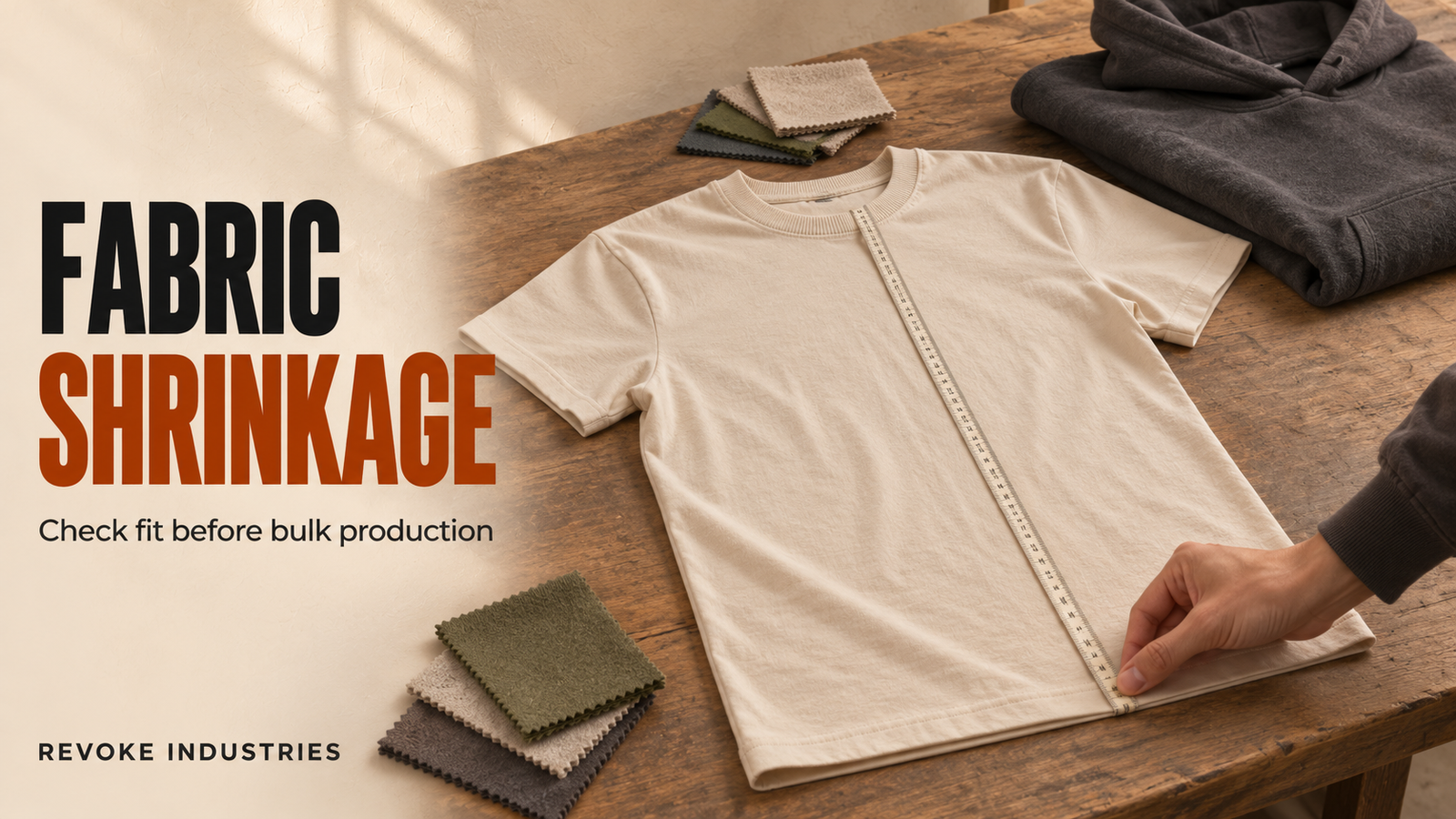
Your medium T-shirt sample fits well when it arrives. After laundering, the body is shorter, while the chest has changed less. The original measurement chart still looks correct, but it does not explain what happened during care.
This is why shrinkage belongs in product development before a bulk order. A useful testing plan connects the material, the intended care conditions and the fit you expect customers to receive. This guide explains what to request, how to read the calculation and how to use the findings in a manufacturing decision.
What does a fabric shrinkage test measure?
Shrinkage is a reduction in a measured dimension. The broader term dimensional change also covers growth. CottonWorks explains this distinction and identifies construction, processing, finishing and garment care among the factors affecting the result.
Keep the directions separate. Length and width do not have to change by the same amount. For a fabric submission, identify the measured directions; for a finished garment, identify the relevant points of measure.
Also distinguish a change in size from other appearance issues. A garment may need additional assessment for twisting, seam appearance or component behavior, even when its measured dimensions are acceptable.
Should you test fabric or the finished garment?
They answer different development questions. A fabric test evaluates the submitted material. A garment evaluation also considers how the assembled product behaves and whether the intended fit remains acceptable.
| Review level | Main question | Information still needed |
|---|---|---|
| Fabric submission | How does this material change under the specified treatment? | Whether it represents the intended production fabric and finish |
| Finished garment | How do the garment's measured positions and appearance change? | Fit review and acceptance against the agreed product requirements |
| Production verification | Does the sampled production output meet the agreed criteria? | A defined sampling and release plan for the order |
The public scopes of AATCC TM135 and AATCC TM150 illustrate the distinction: TM135 addresses fabric dimensional change after home laundering, while TM150 addresses garments.
Ask the testing provider to confirm method suitability, especially for stretch products. TM150's published scope notes limitations for certain stretch fabrics. A method name should be selected for the product being evaluated rather than copied from an unrelated report.
Agree on the test conditions before comparing results
“Shrinks 3%” does not tell the buyer which material was assessed, how it was washed or which direction changed. Two reports using different conditions may not be directly comparable.
Before testing, confirm:
- The exact fabric code, composition, construction, finish and relevant lot.
- Whether the sample is fabric or a finished garment, including the garment size where relevant.
- The test method and edition, together with any agreed deviations.
- The washing procedure and drying method.
- The number of treatment cycles and when measurements will be assessed.
- The sample preparation, conditioning and measuring requirements of the selected method.
- The acceptance criteria and who may authorize the next stage.
The ISO 5077 overview describes dimensional-change evaluation using specified washing and drying procedures. AATCC's TM135 scope likewise provides different home-care parameters. Those choices make the procedure part of the result, not an administrative detail.
Document the agreed care route with the product brief. For a proposed change from line drying to tumble drying, ask the lab and manufacturer whether another evaluation is needed before using the earlier result.
How do you calculate fabric shrinkage percentage?
A useful way to report the result is signed dimensional change:
Dimensional change (%) = [(measurement after treatment − original measurement) ÷ original measurement] × 100
In this convention, a negative result indicates shrinkage and a positive result indicates growth. The published SIST preview of ISO 5077 uses that distinction when expressing results.
The following fictional numbers demonstrate the arithmetic. They are not a specimen-sizing instruction, actual Revoke test results or acceptance limits.
| Measured direction | Before | After | Dimensional change |
|---|---|---|---|
| Length | 50.0 cm | 48.0 cm | −4.0%: shrinkage |
| Width | 50.0 cm | 49.0 cm | −2.0%: shrinkage |
For length, the calculation is (48 − 50) ÷ 50 × 100 = −4%. If the same original 50 cm distance increased to 50.5 cm, its dimensional change would be +1%.
Some communications describe the first result simply as “4% shrinkage.” Confirm the sign convention so the buyer and supplier interpret the report consistently. Keep the original measurement as the denominator and use matching units.
For formal reporting, follow the selected method's requirements for measurements, averaging and rounding. This simple example explains the percentage; it does not replace the full test procedure.
What is an acceptable shrinkage percentage for clothing?
Agree acceptance criteria for the actual product rather than adopting one percentage for every fabric. A fitted top, relaxed hoodie and coordinated set can have different fit and appearance requirements.
CottonWorks emphasizes engineering cotton products around their construction and processing conditions rather than imposing arbitrary shrinkage specifications. For your project, discuss the required outcome with the manufacturer and testing provider, then record the method and acceptable dimensional change for the relevant directions or garment positions.
Also assess the finished measurements after the agreed treatment. A percentage that looks modest in isolation may still affect a fit-sensitive feature. Use the clothing size chart guide to keep measurement definitions clear and the pattern grading guide when reviewing the wider size range.
Do not turn a fabric result into an automatic pattern correction
The pattern team needs representative evidence before changing the garment. Ask which material, processing route and measured conditions the proposed correction is intended to address.
Record whether the adjustment concerns cutting dimensions, the finished measurement specification or another production instruction. A shrinkage allowance and a grade increment between sizes serve different purposes; changing one should not silently change the other.
If the fabric or finishing route changes, ask whether the previous result still represents the new material. Our garment-dyed vs piece-dyed guide explains why the coloring and finishing route belongs in the development brief.
After an adjustment, review the revised sample against the agreed pre-treatment and post-treatment requirements. Keep the relevant pattern and specification revisions together so production does not combine an old chart with a new pattern.
What should you look for in a shrinkage test report?
Begin by confirming that the report belongs to the material or garment you intend to approve. Then connect the findings with the decision being made.
| Report detail | Buyer check |
|---|---|
| Sample identity | Fabric/garment code, submission or lot reference, and garment size where applicable |
| Procedure | Named method and edition, treatment conditions, cycles and stated deviations |
| Measurements | Clear directions or garment measuring positions, units and reported results |
| Assessment | Comparison against the criteria agreed for this product |
| Approval link | Which specification, sample and next-stage decision the report supports |
Read dimensional findings alongside any appearance assessment required by your brief. Intertek's textile-testing overview lists dimensional stability and appearance retention as evaluation areas, alongside other performance tests. Passing one requirement does not establish the others.
For example, shrinkage findings do not confirm color matching, colorfastness or print performance. Keep those decisions connected to the appropriate color and print approvals without merging them into one generic “quality approved” message.
A practical testing request for your manufacturer
The following is a fictional inquiry template. Replace its fields with the actual project details and have the supplier or lab confirm an appropriate procedure:
We are developing [style code] using [fabric code, composition and finish]. Please propose a dimensional-change evaluation for the intended [washing and drying conditions]. Identify the test method/edition, sample requirements and treatment cycles before testing. Report length and width results separately, or the agreed garment positions for a finished sample. Please also confirm how the results will be linked to the revised sample and bulk approval plan.
Ask for the testing cost, sample quantity, expected turnaround and responsibility for follow-up work in the manufacturing quotation. These are project-specific commercial details.
Before bulk release, review the accepted material, finished sample, measurement specification and any open corrective actions together. The pre-production sample approval guide explains how to make that authorization explicit.
Frequently asked questions
Can I do a fabric shrinkage test at home?
An informal wash check can help identify development concerns if you record what you did and compare measurements consistently. Describe it accurately. Do not present it as a formal standard-method result unless the required procedure was followed and documented.
Does pre-shrunk fabric mean zero shrinkage?
The label alone does not establish the remaining dimensional change under your intended care conditions. Request relevant material information and results, then evaluate the actual garment as agreed.
Is 3% shrinkage always acceptable?
No single percentage should be assumed acceptable for every product. Agree the test conditions, affected directions or positions, and limits around the garment's intended fit and performance requirements.
Can fabric shrink differently in length and width?
Yes. Review the directions separately instead of combining them into one unexplained figure. Use the report's sign convention to distinguish shrinkage from growth.
Does a passing fabric test approve the complete garment?
It supports the stated material assessment. The garment still needs the agreed checks for finished measurements, fit, construction, components and other performance requirements before bulk production is authorized.
Plan your fabric and fit checks with Revoke Industries
Revoke Industries offers private label and OEM/ODM apparel manufacturing from Sialkot, Pakistan. Share your garment design, intended fit, fabric preferences, care requirements, size range and quantities.
Ask the team to confirm the material-development, testing coordination and sample-review scope available for your project. Agree on responsibilities and approval checkpoints before moving into bulk production.


Add comment