
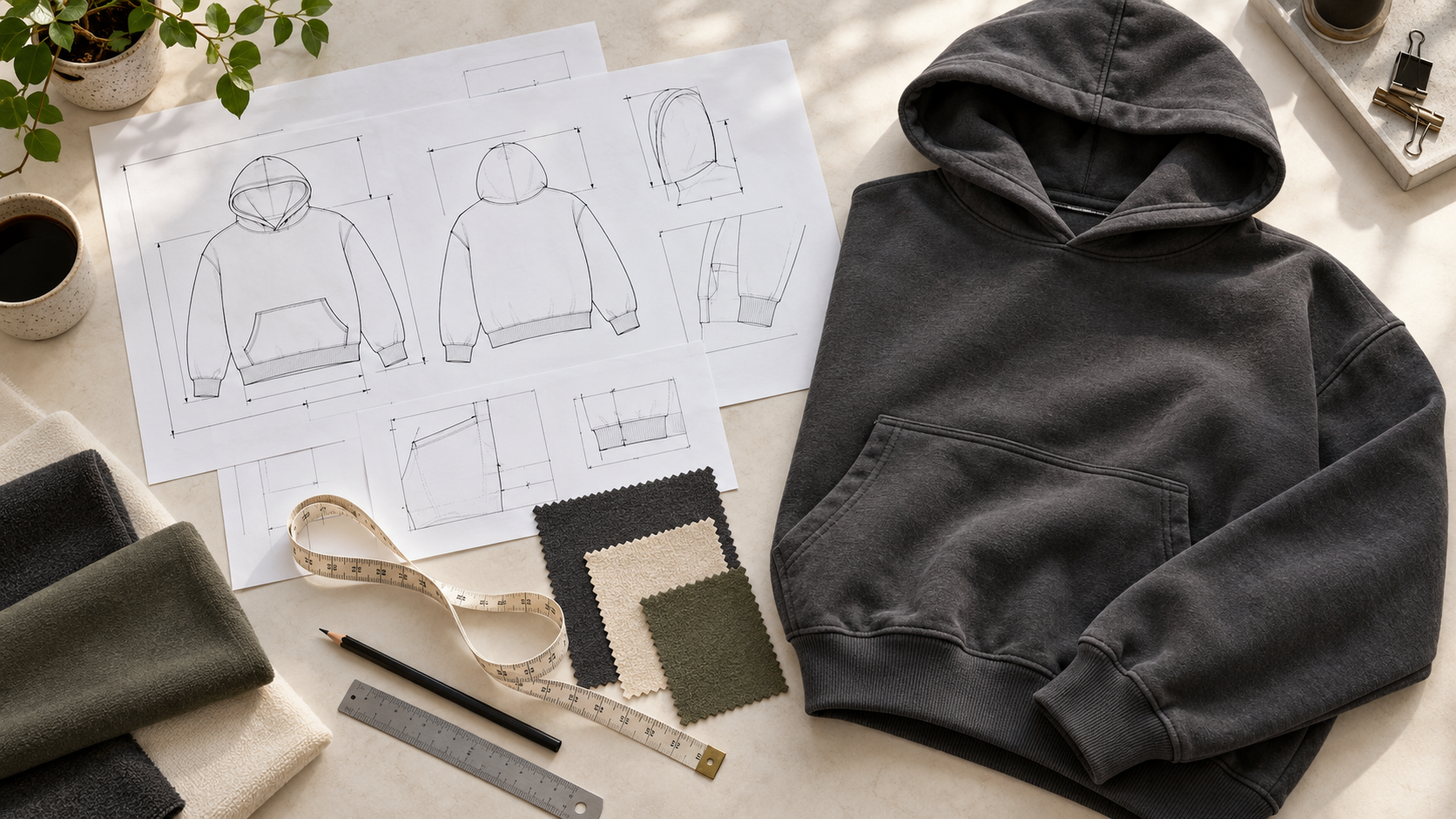
You have a hoodie design, a logo and a reference image. You know how the finished product should look.
Your manufacturer still needs to know how to make it.
Where should the shoulder seam sit? How wide should the chest be? Is the hood lined? Does the artwork stay the same size across every garment size?
A hoodie tech pack brings these decisions into one production document. It gives your manufacturer a clear reference for developing the garment and gives your brand something specific to check when the sample arrives.
What Is a Hoodie Tech Pack?
A hoodie tech pack is a set of drawings and specifications describing how a hoodie should be made. It typically includes technical sketches, fabric and trim details, garment measurements, construction instructions, artwork placement and revision records.
A mockup communicates appearance. A tech pack adds the details needed to interpret that appearance consistently. Techpacker identifies sketches, materials, measurements and construction information as core parts of a clothing tech pack.
For a clothing brand, the practical goal is simple: make important product decisions visible before they become assumptions in the sample room.
What Should a Hoodie Tech Pack Include?
Organize the document around the information someone needs to understand your garment:
- Product name, style code and document version.
- Front, back and relevant detail drawings.
- Main fabric, rib, lining and trim specifications.
- Measurements, measuring methods and agreed tolerances.
- Construction details.
- Artwork files, dimensions and placement.
- Color combinations.
- Labels and packaging.
- Sample comments and approval status.
Not every detail must be finalized before your first conversation with a manufacturer. Mark unresolved decisions clearly and agree on who will develop them.
1. Give the Hoodie a Clear Product Identity
Use a consistent style code to connect your drawings, artwork, sample feedback and quotation.
For example, a fictional brand could name its first pullover hoodie HD-001. Its documents might then use:
- HD-001-Tech-Pack-V01.pdf
- HD-001-Front-Artwork.pdf
- HD-001-Sample-Comments-V01.pdf
This is an illustrative naming system, not a required industry format.
The useful part is consistency. If your collection includes a pullover and a zip-up hoodie, give them separate identities so instructions cannot easily be confused.
Add the date, sample size and current version on the cover. Make it obvious whether the file is an initial development brief or an approved production reference.
2. Show the Garment From More Than One Angle
Include front and back technical drawings, with close-ups where a small detail needs explanation.
For a hoodie, identify the pocket shape, hood construction, cuffs, waistband, seams and any closures. Show details that a front-facing lifestyle image cannot explain.
Technical sketches and construction callouts help communicate how the garment is assembled, while separate artwork information defines the branding.
If you include reference photos, annotate them:
“Use this image for the pocket shape only.”
“Follow this hood appearance, but use our separate measurements.”
This prevents a reference garment from becoming an accidental instruction for every part of your design.
3. Describe Materials Beyond “Premium Fabric”
Create a bill of materials: a list of the components used in the garment. Include the main fabric, rib, lining where applicable, thread, drawcords, hardware and labels.
Record the relevant specifications or approved references for each item. A materials list is a standard part of a tech pack and helps keep component choices organized.
For your hoodie brief, ask these practical questions:
- Have we chosen the main fabric, or do we need options?
- Is the requested color an approved physical reference or an initial preference?
- Should the hood use the same material as the body?
- Are cuffs and waistband specified separately?
- Are any materials in the sample substitutes?
When something remains undecided, write “manufacturer to propose options” rather than filling the gap with an unconfirmed specification.
Keep a record of the selected swatch or material reference once it is approved.
4. Make Hoodie Measurements Unambiguous
A measurement needs both a number and a method.
State the unit, identify the measurement point and show how it is taken. Distinguish flat garment measurements from body measurements and full circumferences.
Measurement diagrams and corresponding specification sheets help the brand and manufacturer measure the same parts of the garment consistently.
For example, the instruction “chest: 64 cm” leaves questions unanswered. A clearer instruction identifies it as a flat chest width and marks the exact measuring position on a drawing.
The number is only an example; it is not a recommended fit specification.
For an oversized hoodie, discuss chest width, shoulder position, body length and sleeves together. Describe the intended silhouette, then have the measurements developed and checked against a sample.
Agree on tolerances for the relevant measurement points. Do not copy a tolerance from an unrelated garment without reviewing whether it suits your product.
5. Specify Artwork Size and Placement
Give each print or embroidery application its own reference.
Include the artwork file, intended decoration method, dimensions, colors and position measured from defined garment points. These are standard elements of a branding specification.
An illustrative instruction could read:
“Center the front artwork on the garment. Finished artwork width: 24 cm. Confirm vertical placement using the annotated drawing.”
That still requires the drawing and the finished sample. It is not a complete decoration specification on its own.
Also decide whether artwork dimensions remain fixed across sizes. Ask the manufacturer to flag any placement or production concerns before sampling.
6. Include Labels and Packing Instructions
Specify the main label, size label, care-label artwork, hangtag and packaging details that form part of your order.
Show dimensions, placement and attachment instructions where relevant. Label and packaging specifications belong alongside the garment instructions so they can be reviewed as part of the finished product.
For your own workflow, keep a simple approval record:
- Label artwork received.
- Placement checked.
- Sample label reviewed.
- Final wording confirmed.
- Packaging sample approved, if requested.
Confirm the actual fiber composition and intended care instructions before finalizing label artwork.
7. Keep Sample Changes in the Main Document
After reviewing a sample, update the tech pack instead of leaving the change only in a message thread.
Suppose your feedback says:
“Reduce the body length by 2 cm.”
Make clear which sample and size that instruction refers to. Update the relevant measurement, record the change and issue a new version.
Ask the manufacturer to acknowledge which version will be used next.
Before bulk approval, review the garment against the latest document using our custom hoodie sample checklist.
Can You Contact a Manufacturer Without a Finished Tech Pack?
Yes. You can start with sketches, reference images, a physical garment and a written brief. The important distinction is between starting a development discussion and approving production.
Revoke Industries accepts buyer-supplied tech packs or design briefs through its OEM and ODM apparel manufacturing services.
If your information is incomplete, ask:
- Which specifications are missing?
- Who will prepare the measurements and technical drawings?
- What development work is included in the quotation?
- Which files will we receive?
- How will revisions be approved?
These questions help establish the scope of the work before sampling begins.
What Should You Send With a Hoodie Quote Request?
Send the latest tech pack together with the commercial details of your proposed order:
- Quantity per style and color.
- Size breakdown.
- Required sample quantity.
- Delivery destination.
- Target arrival date.
- Any specifications still open for discussion.
Ask the manufacturer to identify assumptions in the quotation. For example, if a fabric has not been selected, request that the quoted fabric option be clearly stated.
This makes it easier to compare quotations and understand what could change after development.
Frequently Asked Questions About Hoodie Tech Packs
Is a hoodie mockup the same as a tech pack?
Can I use an AI-generated hoodie image as a design reference?
Do I need separate tech packs for different hoodie colors?
Can I make a tech pack using a spreadsheet and PDF?
Does a tech pack replace sample approval?
How much does a hoodie tech pack cost?
Discuss Your Hoodie Project With Revoke Industries
Revoke Industries provides private label and OEM/ODM apparel manufacturing from Sialkot, Pakistan. Its services include production from buyer designs and development support for private label garments.
Send your hoodie tech pack—or your current design brief—with the intended quantities, colors and delivery destination. Identify any details that still need development.
Contact Revoke Industries or email info@revokeindustries.com to discuss the next steps for your hoodie project.



One comment
Pingback:
Jogger Tech Pack Guide: Measurements, Fabric & Fit