
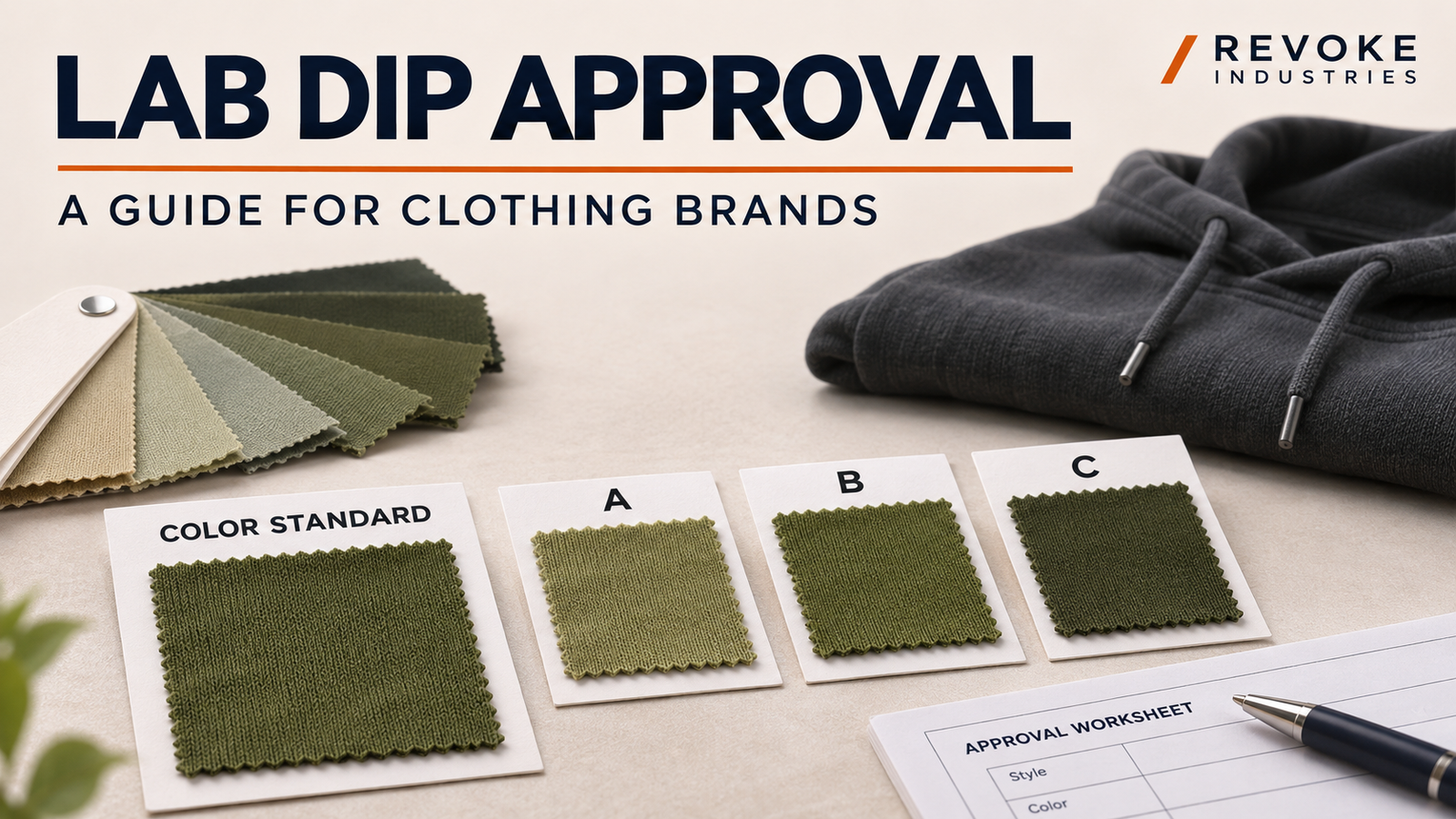
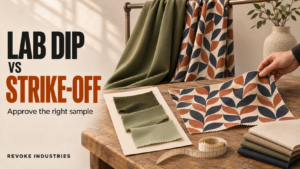
Lab dip approval is the review and sign-off of a small dyed sample against an agreed color standard on a specified material. It helps a clothing brand communicate the target shade before the supplier moves into larger-scale color production.
Imagine developing an olive hoodie. The fabric body looks right in one room, while the rib cuffs look slightly brown in another. A message saying “approved olive” leaves several questions open: which sample, which material and which viewing conditions were approved?
For B2B apparel buyers, a useful color approval connects the reference, material, submission version and decision. This guide explains how to build that record and use it during sampling and bulk-order planning.
What is a lab dip?
A lab dip is a small-scale dyed sample used during color development. The supplier develops a formulation on an identified substrate—the material receiving the color—and submits the result for evaluation.
CottonWorks' lab-dip process guide describes development beginning with a request specifying the color and substrate. Its cotton example uses reactive dyes; other materials and coloring systems can require different procedures.
A lab dip is useful when developing a custom shade. If you are choosing an existing stock fabric color, ask whether a current stock swatch or batch cutting is the relevant approval sample instead. Confirm the supplier's terminology and the scope of the submission.
What does lab dip approval cover?
Keep color approval separate from other product decisions. A good-looking dyed swatch does not demonstrate that the finished hoodie fits, that the print feels right or that the garment meets its care requirements.
| Approval stage | Main question | Separate checks still needed |
|---|---|---|
| Lab dip | Does this submitted shade meet the agreed color requirements on this material? | Bulk reproduction, fabric performance and finished-garment review |
| Bulk fabric shade | Does the actual production fabric meet the color requirement? | Garment assembly, component coordination and final appearance |
| Finished garment | Do the body, trims, decoration and finish work together? | Any outstanding fit, performance and production-release requirements |
Use your hoodie tech pack to connect material codes and color references with the garment being developed. For a tee collection, the same information belongs in the T-shirt tech pack.
Step 1: establish one clear color standard
Give the supplier an identifiable target before asking for a match. This may be a physical textile standard, a retained approved swatch or a digital standard supported by suitable measurement data.
If using a Pantone reference, include the full code and suffix. Pantone explains its color systems: TCX identifies textile references, while TPG relates to its coating and pigment format. Naming the system prevents two teams from working from different representations of a color.
Confirm who holds the master reference and how both parties will access the same standard. Treat a phone photo as an aid to communication rather than the sole basis for a critical color decision.
For an early mood board, a screenshot can help start the discussion. Before approval, resolve it into a standard the supplier can identify and evaluate consistently.
Step 2: identify the fabric and finishing condition
Write the material code beside the color request. Include the composition, construction and intended finishing route, and identify any changes since the previous submission.
For an olive hoodie and jogger set, create separate material entries where needed for:
- The main body fabric.
- Rib cuffs and waistband.
- Hood lining.
- Drawcords and other visible components.
Then decide how these components should relate visually. Some designs need close coordination; others intentionally use contrast. Document the intended relationship instead of describing every component only as “olive.”
If the material or finishing route changes after approval, ask the supplier to assess whether a revised color submission is required. Our garment-dyed vs piece-dyed guide explains why the stage at which color is applied belongs in the production brief.
Step 3: make every submission traceable
Each swatch needs an identity that survives beyond the email or courier envelope. Agree on a simple naming system covering the style, material, color, submission round and individual option.
For example, a fictional hoodie project could use HD-02 / BODY-01 / OLIVE / R2-B. Here, R2-B identifies option B from the second submission round. This is an organizational example, not an industry-mandated code.
Record the date received and keep earlier submissions separate from the current version. When requesting a correction, identify the reference and submission explicitly so the supplier knows what to change.
Ask whether the submitted fabric has received the finishing relevant to the approval. A swatch with an unspecified processing condition leaves an important part of the decision unresolved.
Step 4: agree on lighting and evaluation methods
Two samples can appear to match under one light source and differ under another. X-Rite calls this metamerism. It matters when evaluating components that will appear together in the same garment or set.
Agree on the viewing conditions before reviewing submissions. Where available, a controlled light booth allows comparisons under specified light sources. X-Rite's visual-evaluation guidance explains the role of standardized lighting in color assessment.
For your review, use a repeatable arrangement:
- Compare the sample directly with the agreed standard.
- Keep lighting, background and sample presentation consistent.
- Check the specified alternative lighting conditions.
- Compare body and trim submissions together where coordination is required.
- Record any visible concern with the conditions in which it appears.
If your team lacks suitable viewing equipment, discuss a practical review route with the supplier or an independent color specialist. Ask what evidence can support the decision instead of treating an uncontrolled viewing setup as a formal test.
Should approval use a Delta E number?
Delta E expresses a calculated color difference. A tolerance defines an acceptable limit or range within an agreed evaluation system. Datacolor's color-theory training treats color difference, tolerance, acceptability and visual evaluation as related topics.
If instrumental evaluation is part of your specification, agree on the color-difference formula, threshold, illuminant and observer settings, measurement method and relationship to visual assessment. A number without its evaluation conditions is incomplete.
Avoid copying a universal pass value from an unrelated product. Ask the color professional responsible for the project to help establish requirements appropriate to the material and intended appearance.
Step 5: give feedback the supplier can act on
Feedback should identify the submission, describe the concern relative to the standard and state the next action. Avoid mixing a color correction with an unrelated fabric change unless both are intentionally being requested.
| Unclear comment | More useful buyer feedback |
|---|---|
| “The green is wrong.” | “BODY-01, olive R2-B appears yellower than the master under our agreed viewing setup. Please review and submit a corrected option.” |
| “Use the second one.” | “Approve BODY-01, olive R2-B for the stated color scope. Retain this submission with the approval record.” |
| “Approved, but change the color.” | “Color revision required. This submission is not approved; please address the attached comments before resubmission.” |
These are illustrative wording examples. Describe only differences you have actually observed; leave the technical recipe correction to the supplier's color team.
Give each decision a clear status, such as approved, revision required or awaiting review. If one material is approved while another is pending, record them separately.
Step 6: connect lab approval to bulk shade checks
CottonWorks notes that lab-dip development can involve repeated submissions before a formula is approved and scaled for production. That sequence makes the lab approval an important reference, while the actual bulk output still needs its agreed checks.
Before placing the order, ask:
- Which bulk fabric or garment cuttings will be submitted for shade review?
- How will batches and rolls be identified in the approval record?
- How will shade variation within the order be assessed?
- How will coordinating styles and trims be reviewed together?
- What changes require a new submission or production hold?
- Who can authorize the next production stage?
For a restock, compare the new submission with the retained standard rather than relying on the previous color name. Ask whether any material, supplier or processing change affects the approval plan.
Record the final color and component decisions alongside the pre-production sample approval so the team can connect the accepted shade with the finished product.
A practical lab dip approval record
The fictional example below shows the information a buyer can retain. It is an administrative illustration, not a tested material specification or Revoke Industries production record.
| Record field | Illustrative entry |
|---|---|
| Project and style | Autumn Core / HD-02 hoodie |
| Material | BODY-01; specified cotton sweatshirt fabric |
| Color reference | Brand physical standard OL-01, retained by buyer and supplier |
| Submission | Round 2, option B; received November 17, 2026 |
| Evaluation | Agreed light-booth review; detailed conditions kept with the record |
| Decision | Approved for BODY-01 color only; rib submission still pending |
| Next checkpoint | Bulk shade review and finished-garment approval before the agreed release stage |
| Owner | Named buyer representative; dated decision retained with the tech pack |
Add the actual measurement report where one is required, along with photographs that identify the physical submission. Your record should make the approved scope clear to someone joining the project later.
How to plan approval time and costs
Ask for a project-specific schedule covering standard preparation, submissions, buyer review, possible corrections and bulk verification. Keep your own response deadline visible so an unanswered submission does not disappear from the production plan.
When comparing quotations, confirm whether color development, additional rounds, courier shipments and independent testing are included. Ask whether an existing stock shade provides an acceptable alternative for your collection.
There is no fixed approval duration suitable for every fabric and supplier. Agree on the consequences of a late reference change before committing to a launch date. Our manufacturing lead-time guide explains how approvals fit into the wider schedule.
Frequently asked questions
Can I approve a lab dip from a phone photo?
A photo can help identify a submission and discuss concerns. For a color-critical decision, use the agreed physical standard or a suitable controlled digital evaluation workflow. Confirm the review method before treating an image as approval evidence.
Does one approved lab dip cover the body fabric and rib?
Only if the agreed approval scope explicitly covers both. Identify each material and review the intended relationship between them. Record separate submissions or decisions where needed.
Does approving the color approve colorfastness and shrinkage?
No. Color matching, resistance to color change or transfer, and dimensional performance are different requirements. Keep their test methods, acceptance criteria and approval records clearly identified.
Do I need a new lab dip for every reorder?
Confirm the supplier's reorder process and any material or processing changes. Use retained references and the agreed bulk checks to decide what needs resubmission; a repeated color name alone is insufficient evidence.
Is lab dip approval the same as bulk fabric approval?
No. The lab dip is a development submission. Bulk fabric approval evaluates actual production material against the agreed requirements and retained references.
Prepare a clearer color brief for your next collection
Revoke Industries provides private label and OEM/ODM apparel manufacturing from Sialkot, Pakistan.
Share your tech pack, material preferences, color references, planned quantities and delivery destination. Ask the team to confirm the color-development and approval options available for your specific garment.

Add comment