
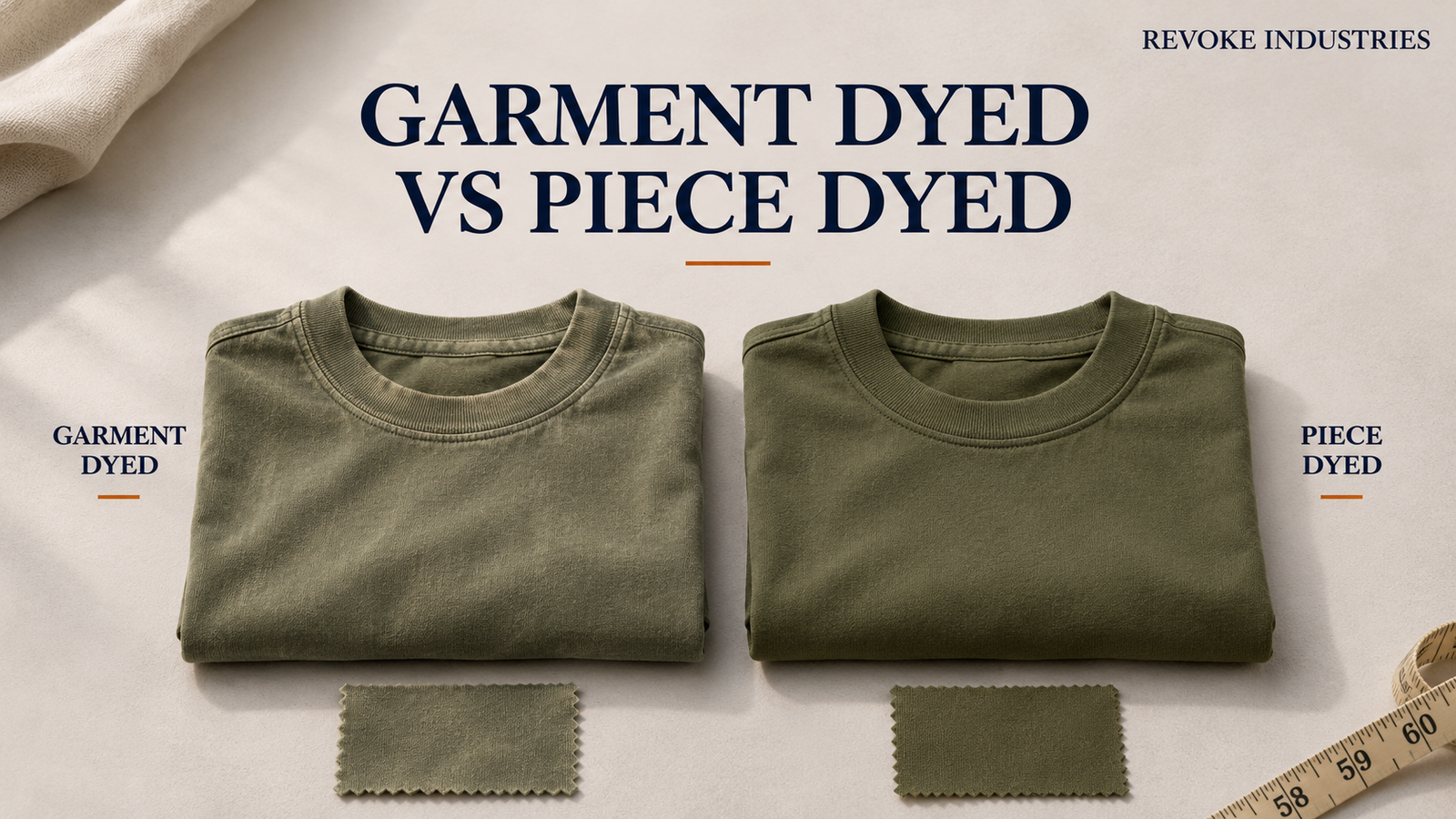
Garment dyed vs piece dyed describes when color is applied. Garment dyeing colors the assembled garment; piece dyeing colors the fabric before cutting and sewing. For a clothing brand, that choice affects the development brief, color approval and checks needed before bulk production.
A washed T-shirt reference may communicate the look you want while leaving the production route undecided. Before asking for a price, identify whether your priority is a particular surface effect, coordinated separates, repeat orders or a combination of these requirements.
This guide helps apparel buyers compare both routes and prepare clearer instructions for manufacturers.
What does garment dyed mean?
Garment dyeing applies color after a garment has been constructed. In a typical cotton program, suitable prepared-for-dye fabric is cut and sewn, then the assembled garment is dyed and finished.
Seams, panels, threads and trims pass through the proposed process together, making component selection part of development. AMANN's garment-dyeing guide explains the importance of selecting sewing threads for the material and dyeing procedure.
For your brief, specify the appearance you want around seams and edges. Decide whether stitching should blend into the garment or remain visibly different, then ask for a finished sample demonstrating the result.
What is piece dyeing?
Piece dyeing applies color to fabric in piece form before that fabric is cut into garment panels and assembled. In this comparison, “piece” refers to the fabric, rather than an individual finished shirt.
A simplified sequence is fabric preparation, fabric dyeing and finishing, followed by cutting, sewing and any specified garment treatments. CottonWorks defines piece dyeing as dyeing fabric rather than substrates such as fibers, yarns or garments.
When considering this route, ask whether the supplier is proposing an available stock color or a custom-dyed fabric order. Those are different sourcing situations, even when both produce piece-dyed clothing.
Garment dyed vs piece dyed at a glance
| Decision | Garment dyeing | Piece dyeing |
|---|---|---|
| When color is applied | After garment assembly | Before garment cutting and assembly |
| What to review | Finished garment, including seams, thread and trims | Fabric shade, followed by the finished garment |
| Appearance | Can support tonal effects; outcome depends on dye and finishing | Can support a consistent base shade; later treatments can alter the appearance |
| Fit approval | Review measurements after the intended dyeing and finishing route | Review measurements after all specified garment treatments |
| Minimum quantities | Confirm garment-order and dye-batch requirements | Confirm fabric availability and any custom color minimums |
| Decoration | Test artwork on the actual dyed and finished garment | Test artwork on the actual fabric and finished garment |
| Reorders | Keep approved shade and finish references | Keep approved fabric shade and finished-garment references |
Neither process name establishes a quality grade. Your specification and approved samples define the result you are buying.
How should your brand choose a dyeing route?
Start with a short product brief covering the customer, fit, intended appearance, decoration and reorder plan. Use that brief to evaluate available processes with the supplier.
For a vintage-inspired capsule, ask how the supplier would develop the desired seam definition and washed surface. Request a full garment so you can judge the complete effect.
For a range of coordinated basics, ask how the supplier will manage shade approval across styles and future batches. Compare actual samples instead of assuming one process guarantees matching colors.
A current supplier example shows why the full recipe matters: Stanley/Stella's garment-dye program combines dyeing after assembly with a separate final wash to develop its particular appearance. This illustrates one supplier's process, rather than a universal method for all garment-dyed clothing.
Color consistency: define acceptable variation
“Washed olive” or “vintage black” leaves room for interpretation. Supply a physical reference where possible and ask how the supplier will approve both the base shade and the finished appearance.
CottonWorks' dyeing guidance identifies color consistency between pieces, lots and laboratory-to-production stages as an important dyeing requirement.
For your order, agree on:
- The reference sample and version used for approval.
- The lighting conditions for visual comparisons.
- The acceptable range of shade and finish variation.
- How different panels, rib trims and stitching should look together.
- How bulk production and repeat orders will be checked.
For a matching hoodie and jogger set, approve the garments side by side. Request a clear plan for controlling their relationship if the body fabrics or trims differ.
Keep one approved reference set with your team and another with the supplier. Record written comments so “approved color” has a shared meaning.
Shrinkage and fit: approve the finished condition
A garment's production wash does not establish how it will behave during customer care. CottonWorks' shrinkage guidance identifies fiber, yarn, construction, processing, finishing and laundering among the relevant variables.
Ask when the measurement specification applies: after dyeing, after finishing or after the agreed care test. Review the same measurement points at each agreed stage.
Your sample review should record:
- Body length, chest width and sleeve measurements.
- Hood, pocket and rib proportions where relevant.
- Twisting, seam appearance and garment balance.
- The washing and drying conditions used.
- Changes after the agreed number of care cycles.
For formal testing, a laboratory can advise on an appropriate method. AATCC lists TM150 for garment dimensional change after home laundering; its separate TM135 method covers fabrics.
Set acceptance requirements with the supplier or laboratory before testing. Our clothing size-chart guide explains how to document measurement methods and tolerances.
Printing, embroidery and trims: confirm compatibility
Plan the order of dyeing, washing, decoration and label attachment during sampling. Approve the final combination, including any process that happens after the garment initially looks complete.
For example, Stanley/Stella explicitly develops its cited range for particular decoration applications. That supplier-specific claim should not be extended to every garment-dyed fabric.
Ask your manufacturer:
- Will the artwork be applied before or after the dyeing and wash stages?
- Which printing or embroidery process is proposed for this material?
- Will threads, rib, drawcords and labels behave as intended?
- What changes appear after curing, pressing and care testing?
- Will the sample use the same materials and sequence as bulk production?
Where color transfer during rubbing is a concern, discuss an appropriate assessment with the supplier or lab. AATCC TM8 covers colorfastness to crocking using a crockmeter; the method name alone does not set your product's pass requirement.
Use our printing and embroidery comparison to prepare the decoration discussion.
Cost, MOQ and lead time: compare complete quotations
There is no reliable universal price difference between garment dyeing and piece dyeing. Request both options against the same product brief, then review what each quotation includes.
Use this purchasing checklist:
| Quote item | Question to ask |
|---|---|
| Fabric | Is the quote based on stock material or custom development? |
| Color | What development, approval and batch charges apply? |
| Minimums | Which minimums apply by style, fabric, color or dye batch? |
| Sampling | Does the price include the actual dyeing, wash and decoration route? |
| Testing | Which checks are included and which are separately charged? |
| Delivery | When does production timing start, and what shipping is included? |
Garment dyeing can allow color decisions after sewing, but that flexibility still depends on suitable inputs, batch capacity and approvals. Treat a faster launch or lower MOQ as a project-specific proposal requiring confirmation.
For a first collection, obtain prices at quantities you can realistically sell. Our MOQ guide explains why a factory's headline minimum needs a style-and-color breakdown.
Garment dyed and pigment dyed describe different things
Garment dyeing describes the stage at which coloring happens. Pigment coloring describes a coloring approach, so a finished garment can receive a pigment treatment.
AMANN's guide distinguishes reactive dyeing from pigment application using binder agents. Ask which system is proposed and how it will produce the desired appearance and performance. A washed finish can involve additional treatment, so a reference image alone does not identify the complete process.
Similarly, a garment-washed product has undergone washing; that description by itself does not establish whether its color was applied before or after assembly.
Is one route more sustainable?
The process name alone cannot substantiate an environmental claim. CottonWorks' sustainable-dyeing discussion emphasizes assessing the wider process, equipment and resource use.
If sustainability forms part of your purchasing criteria, ask for evidence relevant to the proposed production route: water and energy information, chemical controls, wastewater management and any applicable certification scope. Avoid describing a collection as more sustainable solely because it is garment dyed or piece dyed.
What should you approve before placing a bulk order?
Use this checklist alongside your commercial agreement:
- Material: Record composition, construction and target finished weight.
- Color and appearance: Identify the approved shade, finish and variation range.
- Measurements: Name the specification revision and the condition in which it applies.
- Components: Confirm rib, threads, labels, drawcords and hardware.
- Decoration: Approve the actual artwork, placement and production sequence.
- Performance: Agree on care, testing and acceptance requirements.
- Bulk reference: Identify the approved finished sample and how changes will be handled.
- Commercial terms: Confirm quantities, inclusions, delivery responsibilities and timing.
Put these decisions into the tech pack and approval record. Our pre-production sample approval guide explains how to connect written specifications with the sample being approved.
A practical manufacturer inquiry
The following hypothetical brief shows how a buyer can request a comparison without assuming the production route:
We are developing a cotton T-shirt for a US clothing brand. Our reference shows a muted olive shade with subtle seam definition. Please propose suitable garment-dyed and piece-dyed options, identify the fabric and finishing route for each, and confirm minimum quantities by color. Include sampling, decoration testing, measurement approval after finishing, and the information needed to assess a repeat order. We will supply the fit specification, artwork, planned size breakdown and delivery destination.
Attach your current documents and ask the supplier to list unresolved decisions. For hoodies, our hoodie tech-pack guide can help organize the specification.
Frequently asked questions
Is garment-dyed clothing better than piece-dyed clothing?
Either route can support a well-developed product. Choose using the intended appearance, material, decoration, fit and sourcing requirements, then assess the actual samples against those requirements.
Can piece-dyed clothing have a washed appearance?
Yes. Color application and later washing or finishing are separate decisions. Ask the supplier to identify the complete process behind the reference appearance.
Does garment-dyed clothing stop shrinking after production?
Do not assume so. Review remaining dimensional change under the agreed care conditions and compare the finished garment with your approved measurements.
Can garment-dyed clothing be printed or embroidered?
Suitable combinations are possible. Confirm the material, coloring system, decoration method and processing sequence, then approve a finished decorated sample.
Which option has the lower MOQ?
Confirm it for the actual project. Stock fabric availability, custom color requirements and production-batch minimums can affect the workable order quantity.
Discuss your apparel development brief
Revoke Industries provides private label and OEM/ODM apparel manufacturing from Sialkot, Pakistan.
Share your design references, fabric preferences, planned quantities and delivery destination. Ask the team to confirm available dyeing and finishing options, sampling requirements and production feasibility for your specific garment.
Contact Revoke Industries to discuss your project.

Add comment