
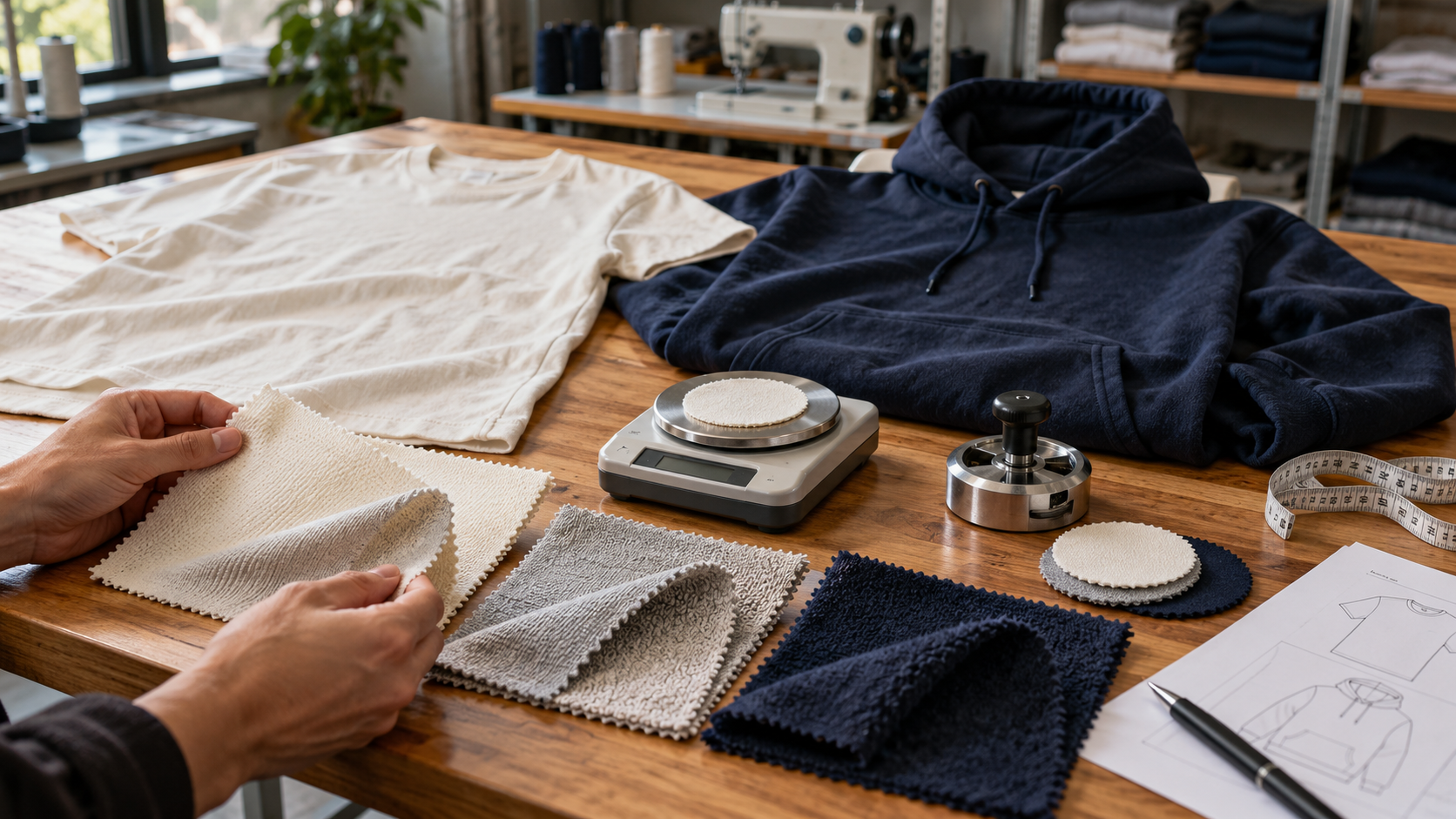
Two manufacturers quote the same oversized hoodie. One offers 320 GSM fabric; the other offers 400 GSM. Which should your clothing brand choose?
The heavier option may suit your design, but the number alone cannot answer that question. You also need to compare fabric construction, composition, finishing, fit, and the way the sample performs after washing.
GSM means grams per square meter. It measures fabric weight per unit of area. A square meter of 240 GSM fabric weighs 240 grams. GSM does not describe the total weight of a finished garment, and a higher number does not automatically mean better quality.
This guide helps US clothing brands understand fabric weights, compare metric and US measurements, and turn a general request such as “a premium heavyweight hoodie” into a useful manufacturing brief.
What does GSM tell you about clothing fabric?
GSM gives you a consistent way to compare how much fabric weighs over the same area. It is useful when reviewing swatches, supplier quotations, and product specifications.
For example, equal-size pieces of 200 GSM and 400 GSM fabric have a two-to-one weight relationship. That does not mean the finished hoodie will weigh exactly twice as much as the finished T-shirt: the garments use different amounts of material and different components.
Think of GSM as one line in your fabric specification. A complete description also identifies the fiber blend, knit or weave, surface finish, color, and agreed acceptance criteria.
What GSM is suitable for T-shirts?
Start with the intended use and silhouette. A light summer tee, an everyday basic, and a substantial oversized T-shirt need different sample comparisons.
| Fabric weight | Possible product direction |
|---|---|
| 120–160 GSM | A lighter tee for warm-weather wear or layering. |
| 160–180 GSM | An everyday casual tee with a moderate fabric weight. |
| 180–220 GSM | A more substantial retail tee; compare the actual drape and feel. |
| 220+ GSM | A heavyweight direction often considered for oversized streetwear. |
These bands follow the examples in Printful’s T-shirt materials guide. They are useful reference points, not universal grading standards. Suppliers may describe the same weight differently.
Before approving a white or pale-colored tee, inspect the actual sample under daylight and while worn. Ask whether its coverage, collar recovery, and shape suit the product you intend to sell.
How should you choose GSM for hoodies?
Choose a hoodie weight by comparing samples with the same intended construction. If you compare a brushed fleece with a loopback French terry, you are changing more than fabric weight.
As a product-specific reference, AS Colour’s Heavy Hood lists 400 GSM fabric. This shows one commercially available heavyweight specification; it does not establish a minimum weight for a good hoodie or describe Revoke Industries’ available stock.
For your own development, ask a manufacturer to suggest two available weights in the same fabric family. Try both in the intended fit and compare the hood, cuffs, pocket, and body. Does the hood hold the shape you want? Does the body hang naturally? Is the finished garment comfortable for the customer’s expected use?
A US audience includes customers in very different climates. Build the brief around a use case such as cool-weather layering or indoor casual wear, rather than assuming one hoodie weight suits every state.
For the inside texture and construction decision, read our French terry vs fleece hoodie guide.
GSM vs oz/yd²: how to compare US fabric weights
US supplier listings may use ounces per square yard, written as oz/yd². This measures fabric weight per area, just as GSM does, using different units.
Convert GSM to oz/yd²: divide GSM by 33.906.
Convert oz/yd² to GSM: multiply oz/yd² by 33.906.
| GSM | Approximate oz/yd² |
|---|---|
| 180 GSM | 5.3 oz/yd² |
| 220 GSM | 6.5 oz/yd² |
| 280 GSM | 8.3 oz/yd² |
| 320 GSM | 9.4 oz/yd² |
| 400 GSM | 11.8 oz/yd² |
If a quotation says only “10 oz,” ask whether it means fabric ounces per square yard or the weight of the finished garment. If it means 10 oz/yd², the equivalent is approximately 339 GSM.
For shipping estimates, request the finished garment weight by size and the packed carton weights and dimensions separately. GSM cannot replace those figures.
Does higher GSM mean better quality?
No. A heavier fabric can fit your product concept, but weight alone cannot confirm softness, durability, color consistency, or workmanship.
Compare the following features alongside GSM:
- Composition: Record the fiber percentages instead of accepting “cotton-rich” as the complete specification.
- Construction and finish: Identify single jersey, French terry, brushed fleece, or the relevant alternative.
- Fit and recovery: Check the garment on a person and examine collars, cuffs, and hems after handling and care.
- Decoration: Approve your actual print or embroidery on the selected fabric.
- Wash performance: Agree on how dimensional change and appearance will be assessed.
CottonWorks’ shrinkage guidance identifies fiber, yarn, construction, processing, finishing, garment manufacturing, and care as relevant factors. A GSM number cannot establish how much a finished garment will shrink.
Our hoodie sample approval checklist covers the broader checks to complete before bulk production.
How to specify fabric weight in a tech pack
Replace a description such as “thick luxury cotton” with a measurable fabric brief. Ask the supplier to confirm what can be produced before you approve the order.
- Name the fabric: State the construction and fiber percentages.
- Set the target weight: Give GSM and, if useful, its oz/yd² equivalent.
- Identify the measurement stage: Clarify whether the target applies to finished fabric before garment production or another agreed stage.
- Agree on tolerance and verification: Ask the supplier to propose an achievable range and measurement approach. Record the agreed terms.
- Reference the approved sample: Keep the swatch identification, color, sample revision, and approval notes together.
Illustrative specification: “Pullover hoodie body: 80% cotton / 20% polyester brushed fleece, target 350 GSM on finished fabric before cutting. Supplier to confirm achievable weight tolerance and verification method. Rib, hood lining, color, decoration, and wash requirements specified separately.”
This example is a starting format, not a statement of Revoke Industries’ inventory or production tolerance. Add your garment measurements and construction details using our hoodie tech pack guide.
Will heavier fabric increase manufacturing costs?
For the same fabric area, a higher GSM means more material mass. However, the final price also depends on composition, usable width, cutting consumption, dyeing, finishing, decoration, order quantity, and construction.
Ask for two itemized quotations that keep the design, quantity, branding, and packing requirements consistent while changing the fabric option. Request confirmation of any other differences so you can understand what drives the price.
A lower unit price is only useful if the sample still meets your intended product requirements. Approve the material and garment together before treating a quote as the basis for a bulk order.
A fabric inquiry you can send to a manufacturer
Hello, we are developing a [T-shirt / hoodie] for a US clothing brand.
Product and fit: [style, fit, size range]
Intended use: [customer, climate, season, layering needs]
Fabric: [construction and fiber composition]
Target GSM: [weight or two weights to compare]
Colors and quantity: [quantity per color and size]
Decoration: [method, artwork size, placement]
Destination: [US city and ZIP code]
Please confirm available fabric options, measurement stage, proposed GSM tolerance, sample cost, MOQ per option, and estimated sampling and production timelines. Please identify any differences from the requested specification before quoting.
Frequently asked questions about fabric GSM
Is 180 GSM good for a T-shirt?
It can be suitable for an everyday T-shirt. Suitability still depends on the fabric, fit, color, decoration, and customer expectations. Approve a physical sample before selecting it for your collection.
Is 400 GSM good for a hoodie?
It can suit a substantial hoodie concept. Compare the sample’s construction, fit, feel, and care performance; 400 GSM alone does not guarantee a comfortable or durable garment.
Is GSM the same as fabric thickness?
No. GSM measures mass per unit area. Thickness is a separate measurement. Two fabrics with the same GSM can have different thicknesses because their fibers, structures, and finishes differ.
Does a 300 GSM hoodie weigh 300 grams?
No. The fabric weighs 300 grams per square meter. The finished hoodie’s weight depends on fabric consumption, size, lining, rib, trims, and decoration.
Can I compare two supplier quotes using GSM alone?
No. Match the composition, construction, finish, measurement stage, garment specifications, and order details. Compare approved samples as well as the written quotation.
Choose fabric for your next clothing collection
Send Revoke Industries your design, target fabric weight, size range, quantities, and US delivery destination. Request confirmation of fabric options and sampling requirements for your project.
Explore our OEM and ODM clothing services or start with a detailed fabric inquiry.
Discuss Your Clothing ProjectReferences: Printful: T-shirt materials; AS Colour: Heavy Hood 5146; CottonWorks: Shrinkage & Skewing. Consulted October 25, 2026. Weight conversions are calculated and rounded. Sampling examples are guidance, not supplier quotations or guaranteed performance specifications.






Add comment