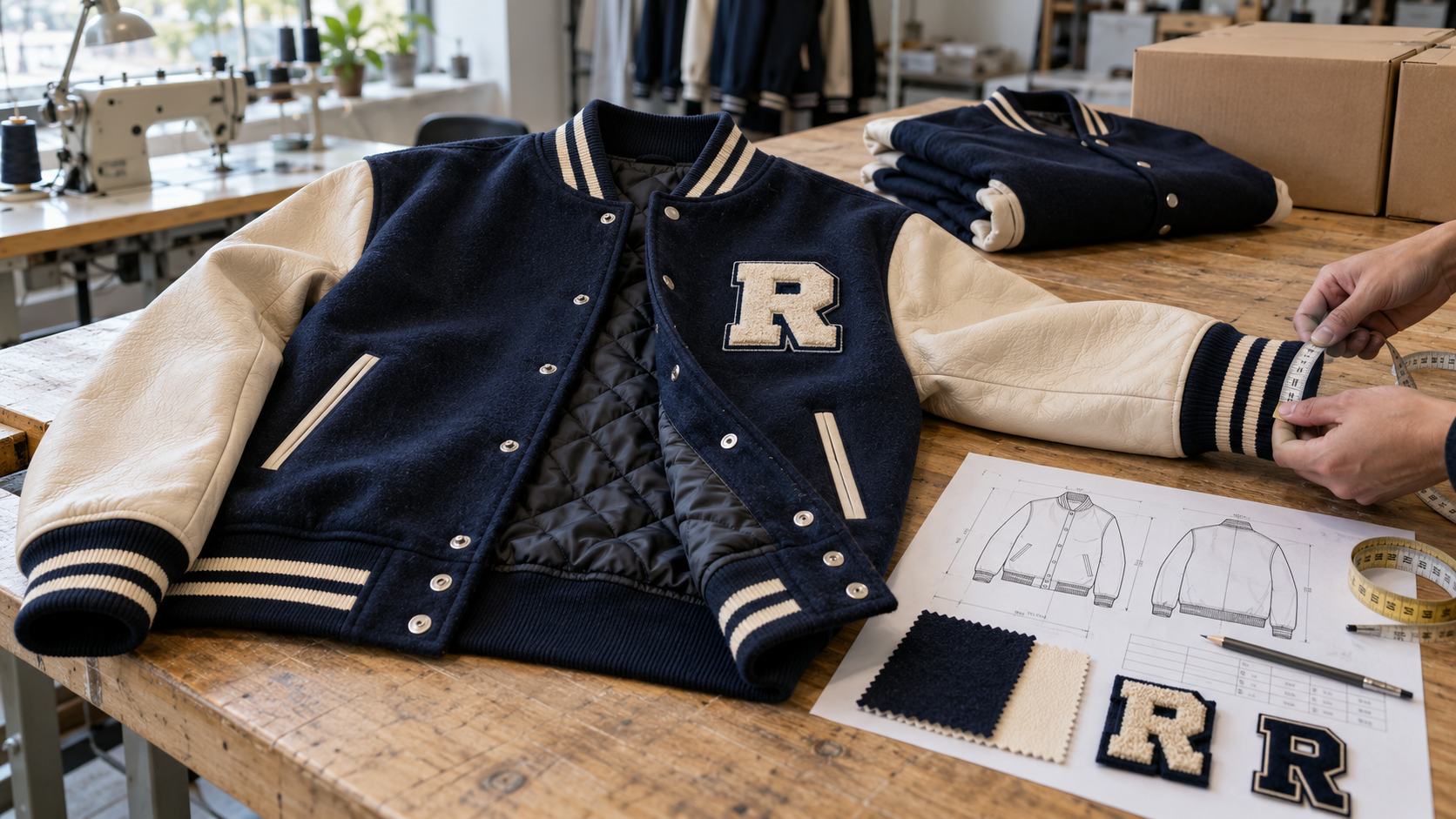
A varsity jacket mockup can look finished long before the product is ready to manufacture. The drawing may show the right colors and chest patch, while leaving the fabric composition, sleeve material, lining, fit, and patch attachment undecided. Each choice affects what the customer receives.
For US clothing brands planning custom varsity jackets, a useful starting point is a complete specification for one style. This guide explains what to choose, what to ask a manufacturer, and what to check before approving a bulk order.
What do you need to order custom varsity jackets? Prepare front and back drawings, body and sleeve material specifications, a size chart, patch artwork with dimensions, lining and trim details, quantities by color and size, and your delivery destination. Approve material swatches, decoration samples, and a finished jacket before authorizing bulk production.
What makes a jacket a varsity jacket?
A varsity jacket, also called a letterman jacket, commonly combines a short jacket silhouette with ribbed cuffs, collar, and waistband, a front fastening, and letter or emblem decoration. Contrasting sleeves are a familiar design choice, but a tonal version can use the same basic structure.
Wool bodies with leather sleeves are one established construction. Modern designs also use wool blends, matching fabric sleeves, or satin-look fabrics. The name describes a style; it does not guarantee a particular composition, warmth level, or quality.
When choosing your starting silhouette, browse our custom jacket collection and identify the details your own design needs.
Which materials should you choose for custom varsity jackets?
Choose materials around your intended customer, season, product feel, and care requirements. Request physical swatches and a written material breakdown. “Premium wool” and “leather-look sleeves” are descriptions that need more detail before production.
| Material direction | Design purpose | What to specify |
|---|---|---|
| Wool or wool-blend body | A structured, traditional letterman appearance | Exact fiber percentages, weight with units, surface finish, color, and care method |
| Leather sleeves | A contrasting texture and distinctive sleeve finish | Leather type, thickness, finish, color reference, and acceptable natural variation |
| Synthetic leather sleeves | A leather-like appearance using a coated material | Coating and backing composition, thickness, flexibility, and appropriate durability checks |
| Matching fabric sleeves | A coordinated, uniform surface across the jacket | Whether sleeves use the exact body fabric, plus lining and reinforcement details |
| Satin-look woven shell | A smooth, lustrous alternative silhouette | Fiber composition, fabric weight, surface appearance, and lining or filling |
On a small screen, swipe the table horizontally to view all columns.
Do not judge warmth from the outer fabric alone
Assess the assembled jacket. Shell construction, lining, any insulation, fit, and openings all contribute to how it feels in use. Ask whether the lining is unfilled or padded, and specify the filling if your design includes it.
“Satin” also does not identify a fiber by itself. Ask what the fabric is made from. For mixed-material jackets, agree on a care method suitable for the complete garment, including its patches, trims, and lining.
Should you use chenille patches or embroidery?
Chenille works well for bold letters and shapes when you want a raised, plush surface. Embroidery is worth considering for outlines, smaller lettering, and details. Some patch designs combine the two. Ask for a physical decoration sample because artwork on a screen cannot show the finished texture or stitch definition.
Decoration supplier STAHLS’ explains how combining chenille with direct embroidery can add finer detail to a textured patch. The result still depends on your artwork, patch size, and production method.
- Chest letters: Specify overall height, width, border, backing color, and placement.
- Back artwork: Check its scale on the actual jacket and whether it affects flexibility or drape.
- Sleeve patches: Confirm their position with the sleeve worn naturally, rather than only laid flat.
- Names or small text: Review legibility in the smallest version you intend to use.
Also confirm whether decoration is attached before or after the lining is assembled. Review the inside finish and ask the manufacturer to validate the attachment method on your actual material. For a wider comparison, read our guide to printing and embroidery methods.
How should a varsity jacket fit your US customers?
Decide whether the jacket will be regular, cropped, relaxed, or oversized, then define that fit through garment measurements. A size label such as “US large” is not enough to establish the intended shape.
Your measurement chart should include chest width, body length, shoulder width where applicable, sleeve length, upper-arm width, cuff opening, and hem dimensions. Define where each measurement begins and ends, and agree on tolerances.
Fit-test the sample over the layer your customer is likely to wear. A jacket intended for a hoodie underneath needs to be evaluated that way. Check reach, elbow movement, shoulder comfort, and whether the front closes without pulling. Ask whether additional sizes should be sampled before approving the full range.
What affects the cost and minimum order quantity?
Custom varsity jacket pricing depends on the specification. Materials, decoration, construction, quantities, and delivery requirements all influence the quote. A simple fabric jacket and a leather-sleeve jacket with several large patches should not be compared on unit price alone.
Ask the manufacturer to separate these items:
- Pattern development, garment sampling, and revisions.
- Body fabric, sleeves, lining, ribbing, snaps or zippers, and pockets.
- Patch development, embroidery setup, decoration, and attachment.
- Brand labels, packaging, inspection, and shipment.
There is no universal MOQ for custom varsity jackets. Confirm whether the minimum applies to each style, color combination, fabric, or total order. Custom ribbing and patches may have their own supplier minimums.
For example, 120 jackets divided across three color combinations and five sizes would average eight pieces per color-size combination. That calculation is a planning example, not a Revoke Industries MOQ. Ask whether your intended breakdown is feasible before committing to it.
Our clothing MOQ guide explains how variations can change an order. To simplify an initial collection, consider fewer color combinations and a consistent base jacket, subject to your customer's needs.
What should you check on a varsity jacket sample?
A finished sample should represent the materials and construction intended for production. If a substitute is used during development, record it and confirm how the final version will be approved.
- Material match: Compare the body, sleeves, lining, and ribbing with approved references under consistent lighting.
- Fit and measurements: Measure the jacket using the agreed method, then assess it on a person over the intended clothing layer.
- Patch execution: Check shape, spelling, dimensions, borders, placement, and attachment.
- Ribbing: Inspect stripe alignment, seam joins, stretch, and recovery at the collar, cuffs, and hem.
- Fastenings and pockets: Operate the snaps or zipper and check pocket access, reinforcement, and symmetry.
- Interior finish: Look for lining tension, exposed rough areas, loose threads, and uncomfortable seams.
- Care performance: Agree on appropriate care testing for the assembled jacket and review appearance, dimensions, and decoration afterward.
Send one consolidated revision list with photos and measurable corrections. Keep the approved sample and specification version as references for production. Discuss inspection checkpoints and the handling of defects before placing the bulk order.
How far ahead should you place a bulk order?
Build the schedule backward from the date the jackets need to reach your stockroom. Include design development, material approval, patch sampling, garment revisions, production, inspection, and transport.
Ask what starts the production clock: a deposit, final sample approval, material availability, or a combination of these. Get separate estimates for production completion and delivery. For a seasonal launch, confirm current factory capacity before announcing an arrival date.
US buyers comparing overseas quotes should also confirm the delivery terms and which shipping or import-related charges are included. Our ordering guide for US clothing brands covers the broader preparation process.
What should you send to a varsity jacket manufacturer?
A complete inquiry helps the supplier identify missing details and prepare a relevant quotation. Use this template:
Hello, we are developing custom varsity jackets for our US clothing brand. Please review the attached artwork and specifications.
Fit and size range: [Regular, relaxed, or oversized; sizes and measurements]
Body and sleeves: [Composition, weight or thickness, and colors]
Lining and trims: [Lining, filling if needed, ribbing, pockets, and fastening]
Decoration: [Patch or embroidery method, sizes, and placements]
Quantity: [Total and breakdown by color and size]
Branding: [Labels and packaging]
Delivery: [US city, ZIP code, and desired arrival date]
Please confirm the MOQ per style and color combination, sampling and revision costs, material options, estimated production timing, and exactly what the quotation includes.
Frequently asked questions
Can I create varsity jackets with my own brand label?
Yes, private label production can include agreed brand labels, size labels, decoration, and packaging. Confirm the available options and their minimums with your manufacturer. Approve the placement and finish on the sample.
Can varsity jackets be made without leather sleeves?
Yes. You can discuss fabric sleeves or synthetic alternatives as part of the design. Ask for the exact material specification and evaluate the finished sample, since appearance, flexibility, and care requirements vary.
Can I order a sample before buying in bulk?
Request a development sample and confirm its cost, shipping charge, revision terms, and intended materials. Also ask whether sample charges are separate from bulk pricing. Obtain written terms for your specific project.
Are varsity jackets suitable for a streetwear collection?
They can be, if the fit, artwork, materials, and price match your audience. Develop a sample and gather feedback from intended customers before deciding how many colors or sizes to produce.
Can every jacket have a different name or number?
Ask whether individual personalization is available. Supply an approved name, number, and size list, and confirm any additional charges or schedule changes. Check the exact spelling and placement before production.
Plan your custom varsity jackets with Revoke Industries
Revoke Industries offers custom jacket and private label apparel manufacturing from Sialkot, Pakistan. Send your design, preferred materials, quantities, and US delivery details so our team can review the project.
Explore our OEM and ODM manufacturing services or request a varsity jacket quotation.
Add comment