
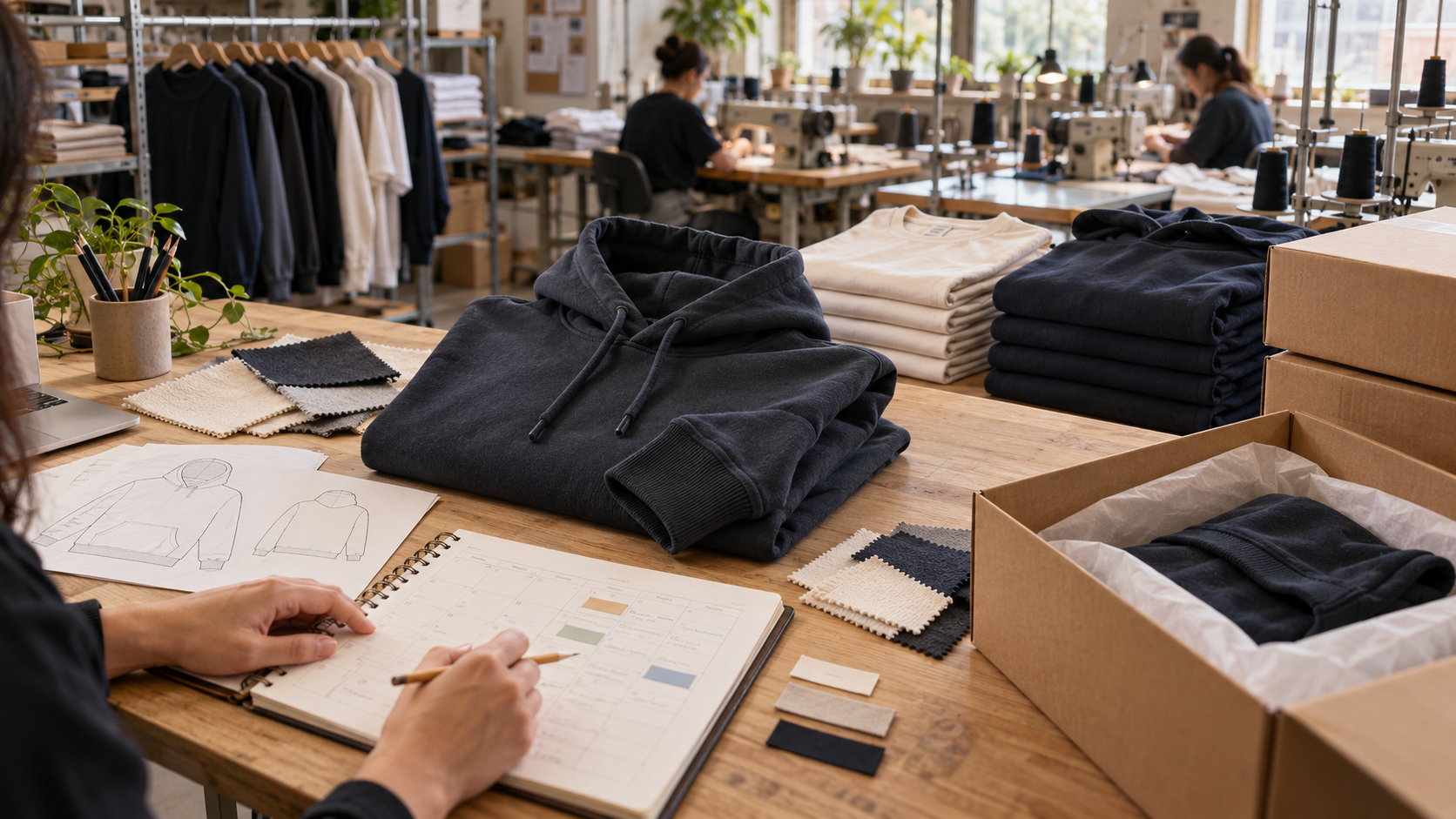
A manufacturer quotes “four weeks,” and you schedule your clothing launch four weeks later. Then you discover the quote starts after sample approval and ends when the order is ready to leave the factory.
Sampling, revisions, shipping, and receiving were never included.
For US clothing brands, the useful question is not simply how fast a factory can sew a hoodie. It is when the complete order can reach your delivery address, pass your receiving checks, and become available to sell.
Clothing manufacturing lead time depends on the product, material availability, approvals, quantity, factory schedule, and delivery route. There is no reliable single duration for every order. Ask for a dated schedule covering development, sampling, materials, bulk production, inspection, packing, and delivery. Confirm exactly when each quoted period starts and ends.
What does clothing manufacturing lead time include?
Suppliers may use “lead time” to describe different parts of an order. Separate the following periods before comparing quotations.
| Timeline | What to clarify |
|---|---|
| Sample lead time | Does it end when the sample is finished, dispatched, or delivered? Are revisions and sample shipping included? |
| Bulk production lead time | What approvals, materials, payment, and production-slot conditions must be complete before it starts? |
| Delivery lead time | Which origin, destination, transport service, clearance steps, and final delivery arrangements does the estimate cover? |
| Launch readiness | How much time do you need after arrival for counting stock, checking quality, receiving inventory, and preparing fulfillment? |
Also ask whether a quotation uses working days or calendar days. Record actual milestone dates where possible, including any factory closures that affect your order.
Stage 1: Finalize the product brief
A factory cannot accurately schedule an undefined product. Prepare the garment drawings, fabric requirements, measurements, artwork, labels, packaging, and quantity breakdown before requesting a firm production plan.
For example, “200 oversized hoodies” leaves several decisions unresolved. The supplier still needs the fabric, colors, sizes, decoration, and construction details to assess the work.
Use our hoodie tech pack guide and clothing size chart guide to prepare those details. If you need design or pattern development, include that work explicitly in the schedule.
Techpacker’s manufacturing overview separates material sourcing, pattern making, and sampling from later production activities. That distinction helps explain why a sewing estimate is not a complete launch timeline.
Stage 2: Allow time for sampling and decisions
A sampling schedule should account for making the sample, sending it to you, reviewing it, and completing any agreed revisions.
Decide who can approve fit, fabric, and decoration before the sample arrives. Combine feedback into one dated document with marked photos and measurement notes. Conflicting messages from several team members make the next revision harder to define.
Ask what happens if a sample needs changes: will the next sample require new fabric, a pattern adjustment, new decoration setup, or another courier shipment? Request the revised timeline before assuming the original dates still hold.
Keep approval specific. A fit approval on substitute fabric does not automatically confirm the final color, finish, or decoration. Our custom hoodie sample checklist helps structure the review.
Stage 3: Confirm material and trim readiness
Ask whether the proposed fabric is available in the required quantity and color. A swatch proves that a material exists; it does not confirm that enough is ready for your order.
Include zippers, rib, drawcords, custom labels, patches, and packaging in the materials check. Request a readiness date for any component that could hold up the next operation.
Techpacker’s discussion of production delays identifies late raw materials as a cause of missed schedules. Ask which components are confirmed and which still depend on another supplier.
If the factory proposes ordering materials before final sample approval, clarify exactly what you are authorizing and what happens if the specification changes. Do not treat an early material purchase as approval of the complete garment.
Stage 4: Schedule bulk production, inspection, and packing
Confirm the conditions that release the order into production. These may include an approved sample, final specifications, material readiness, agreed payment, and a confirmed factory slot.
Techpacker’s pre-production guide describes coordinating production after sample and material preparation, including planned cutting and shipment dates.
Request milestones you can verify: cutting start, sewing progress, decoration completion, final inspection, and packed-order readiness. The sequence can vary by product and decoration method, so ask the manufacturer to explain its plan.
Clarify whether the quoted duration includes final inspection and packing. If an inspection identifies a problem, the schedule may need time for correction and reinspection before shipment.
Stage 5: Plan delivery to your US address
“Ready to ship” is not the same as “received at your warehouse.” Obtain a shipment-specific estimate using the origin, US destination ZIP code, service, carton dimensions, and shipment weight.
Ask who will handle booking, shipping documents, clearance communication, and delivery appointments where required. Confirm whether the estimate starts at factory pickup, carrier acceptance, or another event.
DHL’s US customs guidance lists incomplete documents and delayed responses to information requests among reasons shipments can be held up. Keep an informed contact available to respond promptly.
For the wider ordering process, read our guide to ordering custom clothing from Pakistan for a US brand.
An illustrative clothing production schedule
Planning example only: The following 11-week schedule uses invented allocations to show how separate stages add up. It is not an industry average, a recommended allowance for every order, or a Revoke Industries quotation. Replace every allocation with project-specific dates confirmed by the relevant parties.
| Example period | Allocated work |
|---|---|
| Week 1 | Complete the brief, resolve specification questions, and confirm the development plan. |
| Weeks 2–4 | Develop and ship samples; allow buyer review and an assumed revision cycle. |
| Week 5 | Complete remaining material and trim readiness checks and release production. |
| Weeks 6–8 | Carry out bulk production, agreed inspection, and packing. |
| Weeks 9–10 | Allocate time for pickup, transport, clearance, and delivery under the chosen route. |
| Week 11 | Reserve time for receiving checks, launch preparation, and contingency. |
The example totals 1 + 3 + 1 + 3 + 2 + 1 = 11 weeks. Its final week is not a guarantee against every delay. A new revision, unavailable fabric, or different shipping route could require a longer plan.
Some tasks may overlap. For example, artwork preparation can happen while a fit sample is reviewed. Only shorten the combined schedule when the factory confirms that the overlapping work is feasible and its prerequisites are satisfied.
How to work backward from your launch date
- Set the stock-ready date. Decide when inspected inventory must be available for fulfillment, before the public launch.
- Allow for receiving and delivery. Use a shipment-specific estimate and a contingency appropriate to your deadline.
- Set the packed-order deadline. Confirm when the factory must finish production, inspection, and packing.
- Calculate the approval deadline. Work backward through production and outstanding material requirements.
- Schedule development and sample review. Include courier time, decision time, and the revision allowance agreed for the project.
Maintain one shared schedule with a responsible person, target date, current forecast, and next required action for each milestone. If an approval slips, ask which later dates change instead of leaving the original launch plan untouched.
Can you reduce clothing manufacturing lead time?
Ask the manufacturer which changes would shorten your specific order. Possible options include available materials, fewer color variations, simpler decoration, or an existing approved pattern.
A repeat order may need less development if the specifications remain unchanged, but confirm material availability and factory capacity again. Previous delivery performance is useful context, not a reservation for the next order.
For an urgent launch, request a written comparison of the feasible options, costs, and revised dates. Faster freight cannot recover time from an unfinished sample approval. Keep the checks needed to confirm that the product meets your requirements.
Send this timeline request to your manufacturer
We are planning a collection for the US market.
Quantity: [units by style, color, and size]
Development status: [tech pack ready / sample under review / repeat order]
Fabric and decoration: [specifications]
Delivery address: [city, state, ZIP code]
Required stock-ready date: [date]
Please provide separate estimates for sampling, revisions, material readiness, bulk production, inspection, packing, and delivery. Confirm whether the durations use working or calendar days, what starts each period, and the approvals needed to keep the proposed dates.
Frequently asked questions
How many weeks does custom clothing manufacturing take?
There is no single reliable duration for every custom order. Request a project-specific schedule covering development through delivery. The 11-week example above demonstrates planning arithmetic only; it is not a standard turnaround.
Does production lead time include shipping?
Only if the quotation explicitly includes it. Ask whether the stated endpoint is production completion, packed-order readiness, dispatch, or delivery to your address.
When does bulk production lead time start?
Confirm the start conditions in writing. They may depend on sample approval, final specifications, materials, payment, and factory scheduling rather than the date of your first inquiry.
Will a small clothing order always be faster?
No. A smaller order can still require material sourcing, pattern development, decoration setup, and sample approval. Ask whether quantity changes the schedule for your actual product.
Can I change the design after approving the sample?
Ask the manufacturer to assess the change before proceeding. It may affect materials, patterns, decoration, price, and delivery dates. Record the new specification and approval status together.
Request a production timeline for your collection
Send Revoke Industries your product brief, quantities, development status, and US delivery destination. Include the date you need stock ready so the project can be reviewed against your requirements.
Explore our OEM and ODM clothing services and request an order-specific quotation and schedule.
Discuss Your Production TimelineReferences: Techpacker’s manufacturing overview, pre-production guide, and production-problem guidance; DHL’s US customs questions guide. Sources are linked beside the relevant discussion and were consulted October 27, 2026. All numerical scheduling examples are illustrative.
Add comment