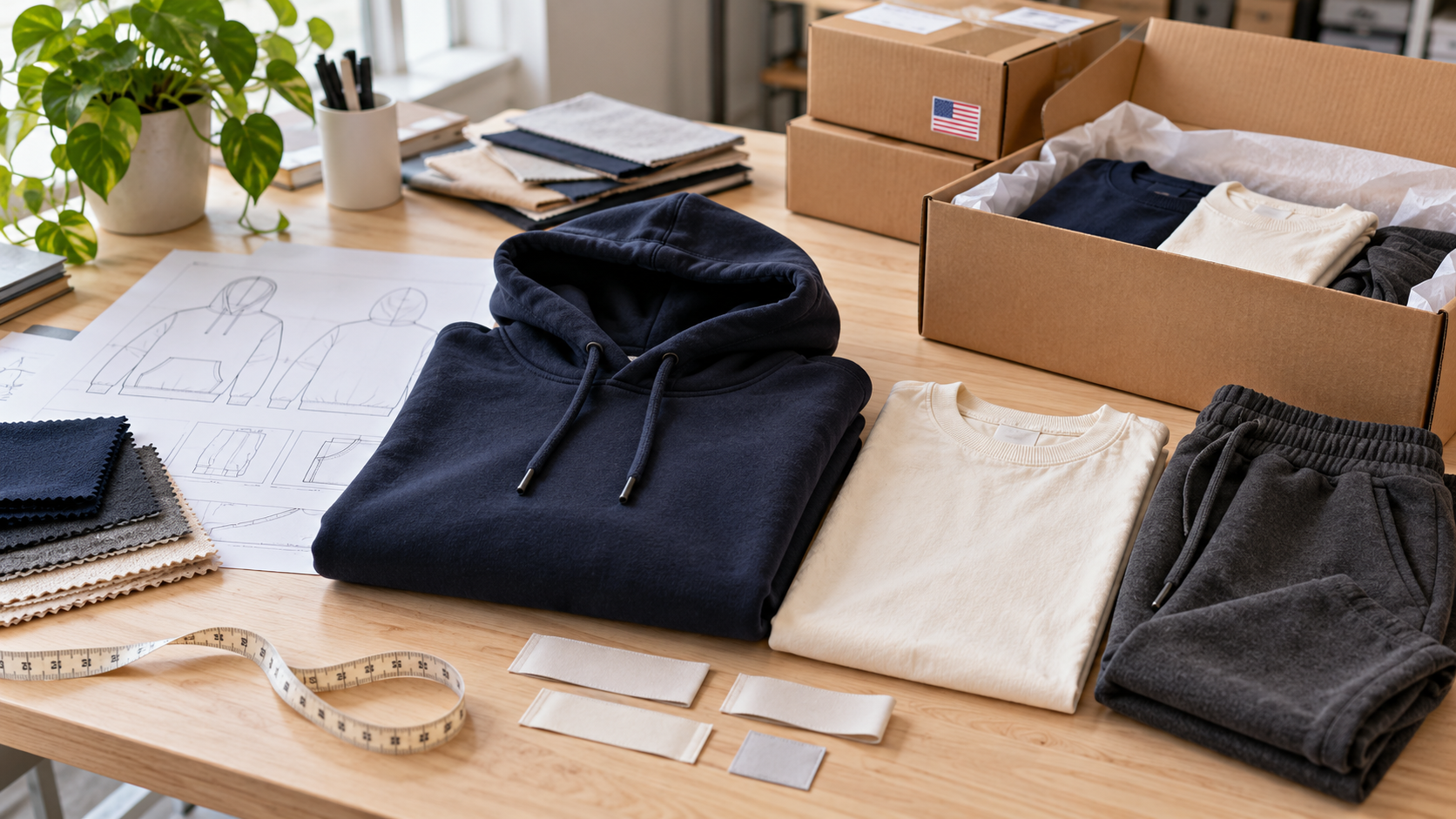
To order custom clothing from Pakistan for a US brand, prepare a clear product brief, confirm quantities and pricing, approve physical samples, finalize labels, and agree on shipping and import responsibilities before bulk production.
When choosing a clothing manufacturer for US brands, evaluate the supplier’s ability to reproduce your product and support your delivery plan—not just the quoted price per piece.
Your first clothing order connects several decisions: what you want to sell, how it should fit, what customers will pay, and when the inventory needs to arrive.
For a US streetwear label ordering hoodies, T-shirts or tracksuits from overseas, a clear approval process helps keep those decisions aligned. This guide explains what to prepare and what to confirm before committing to production.
What Should US Brands Look for in a Clothing Manufacturer?
Look for evidence of relevant product capability, a clear sampling process, written specifications and transparent commercial terms.
Start with the garment you actually need. A supplier’s general apparel portfolio does not tell you whether it can achieve your intended hoodie fit, print treatment or finishing details.
Request relevant production examples, then explain which details matter to your project. If possible, arrange a video discussion with the person responsible for development.
| Area | Question to ask | What to obtain |
|---|---|---|
| Product capability | Have you produced garments with similar requirements? | Relevant examples and a proposed development approach |
| Specifications | Which details still need to be developed? | A written list of open decisions |
| Minimum quantities | Does the minimum apply per style, color or material? | An itemized quantity breakdown |
| Sampling | What does the sample include, and how are revisions handled? | Sample scope, charges and approval steps |
| Delivery | What is included in the shipping quotation? | Destination, delivery terms and assigned responsibilities |
1. Define Your Product Before Requesting a Price
A request for “premium oversized hoodies” leaves important decisions unresolved. Describe the garment in enough detail for the manufacturer to assess it.
- Garment type: pullover hoodie, zip hoodie, T-shirt or tracksuit.
- Intended fit and reference images.
- Preferred fabric composition, weight and interior finish.
- Colors and planned quantity per color.
- Size range and measurement requirements.
- Artwork dimensions and placement.
- Labels, hangtags and packaging.
- US delivery address or ZIP code.
Mark undecided details clearly. If you need fabric suggestions, request options instead of approving an unspecified material.
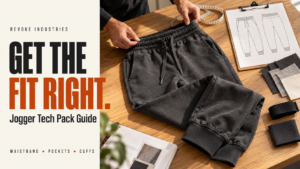
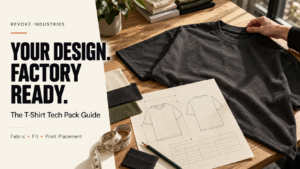
Use our hoodie tech pack guide to organize your drawings, materials and measurements.
2. Define US Sizing With Actual Measurements
Do not rely on the instruction “use US sizes.” Provide your intended garment measurements and a clear measuring method.
State whether each value is a flat garment measurement, a full circumference or a body measurement. Choose one master unit system so conversions do not introduce conflicting instructions.
Illustrative measurement clarification:
“Chest: 25 inches” is incomplete. A clearer specification states that it is a flat chest width, shows the measuring location on a drawing, and identifies the sample size.
The number is an example, not a recommended US size.
Approve the base-size fit, then agree on how the other sizes will be developed and checked. Use customer measurements, previous sales and fit feedback to choose your size breakdown.
3. Confirm MOQ Before Splitting Your First Drop
Ask whether minimum order quantities apply separately to each style, color, fabric or decoration.
A total order of 100 garments might be divided across several specifications. That does not automatically mean it meets the supplier’s minimum for each one.
Request a quotation that lists every style and color separately. Also ask whether labels or custom packaging have their own minimums.
Our clothing MOQ guide explains the questions to resolve before planning a small batch.
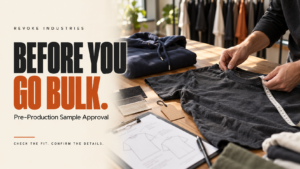
4. Approve a Physical Sample Before Bulk Production
A physical sample lets you evaluate fit, material feel, construction and decoration together.
Confirm whether it uses the intended bulk fabric, trims and branding. If any components are substitutes, record them and agree on how the final versions will be approved.
Review the sample for:
- Measurements and fit on a person.
- Fabric appearance and comfort.
- Seams, pockets, cuffs and closures.
- Print or embroidery dimensions and placement.
- Labels and packaging.
- Results after the agreed washing and drying test.
Send one consolidated revision document with annotated photos. Identify the sample version and request acknowledgment of the changes before another sample or bulk production begins.
Follow our custom hoodie sample approval checklist for a more detailed review.
5. Review Labels for Clothing Sold in the United States
For most textile and wool products, FTC guidance requires disclosure of fiber content, country of origin, and the identity of the manufacturer or another responsible business. Covered clothing also needs appropriate care instructions.
Review the FTC textile labeling guidance and care-label guidance for your specific product before approving label artwork.
Confirm the actual composition and manufacturing origin. Base care instructions on reliable information about the finished garment, including its decoration. This is a starting point for label review, not a complete product-compliance checklist.
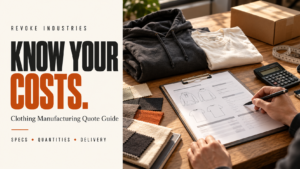
6. Compare the Delivered Cost, Not Only the Factory Price
A useful sourcing comparison includes the costs required to get inventory to your agreed US destination.
Ask which of these are included or charged separately:
- Garment production and decoration.
- Pattern development, samples and revisions.
- Labels, packaging and cartons.
- International transport and insurance.
- Customs duties, applicable taxes and clearance charges.
- Final delivery to your address or fulfillment warehouse.
Do not assume that “shipping included” means every import-related charge is covered. Have the supplier identify the delivery terms, named destination, importer of record and payment responsibilities.
Ask a licensed US customs broker to confirm classification, current duties and entry requirements for your actual products. CBP notes that using a broker does not remove the importer of record’s responsibility for correct entry documentation.
Reference: CBP tips for new importers and exporters .
7. Plan Backward From Your Inventory-Ready Date
Your production completion date is different from the date inventory is ready to sell in the United States.
Build your schedule around development, sample transit, revisions, material sourcing, production, inspection, international shipping, customs clearance and warehouse receiving.
Ask what starts the quoted production lead time. It may depend on final approvals, payment and material availability rather than the date of your first inquiry.
For a seasonal launch or event, provide both the public launch date and an earlier required inventory-receipt date. Allow time for counting stock, checking quality and preparing customer orders.
8. Confirm Packing and Receiving Requirements
If the order will go to a third-party fulfillment warehouse, obtain that warehouse’s receiving instructions before packing.
Confirm SKU labels, size identification, carton contents, packing lists and any delivery appointment requirements. Share the approved instructions with the manufacturer.
Agree on how shortages or quality concerns will be reported. Keep the purchase order, approved specifications and sample references together so both sides can assess any issue against the same information.
Example Inquiry for a US Streetwear Brand
Adapt this starting brief to your project. Replace the bracketed fields before sending it.
Hello Revoke Industries,
We are a US-based clothing brand developing a [hoodie/T-shirt/tracksuit] for our next collection.
Our planned quantity is [quantity] per color, with sizes [size range]. We have attached our [tech pack/reference images] and artwork.
Please confirm suitable fabric options, MOQ, sampling charges, revision terms and bulk pricing. Please identify any details that still need development.
Delivery is to [city, state, ZIP code]. Our target inventory arrival date is [date]. Please quote the shipping scope and explain which import or delivery charges are excluded.
Frequently Asked Questions From US Clothing Brands
Can a US startup order private-label clothing from Pakistan?
Yes, subject to the supplier’s project requirements. Share your garment specifications, quantities and delivery destination to confirm MOQ, sampling and shipping arrangements.
Can I order 50 custom hoodies for my US brand?
Ask about your exact design, fabric, colors and branding. A 50-piece order may be possible for some specifications, but it should not be assumed. Request written confirmation of the minimum per style and color.
Can I start without a completed tech pack?
You can begin with reference images and a written brief. Agree on who will develop the missing measurements, drawings and material specifications, and what that work costs, before sampling.
How long does clothing production and shipping to the USA take?
Request a project-specific schedule. Development, revisions, material availability, production, transport and clearance all affect arrival. Confirm the conditions that start each quoted lead time.
Does a shipping quote include US customs duties?
Only rely on what the written quotation and delivery terms include. Ask who handles clearance, who is the importer of record, and which duties, taxes or delivery charges remain payable separately.
Is Revoke Industries located in the United States?
Revoke Industries is based in Sialkot, Pakistan. US brands can contact the team about private-label and OEM/ODM manufacturing, with project details and delivery arrangements confirmed through a quotation.
Discuss Your US Clothing Brand’s Next Collection
Revoke Industries provides private-label and OEM/ODM apparel manufacturing from Sialkot, Pakistan, including hoodies, T-shirts, tracksuits and other custom apparel.
Send your product brief, planned quantities, size range and US delivery ZIP code. The team can review your requirements and confirm sampling, minimum quantities and quotation details.
Request a Project QuoteEmail: info@revokeindustries.com
Add comment