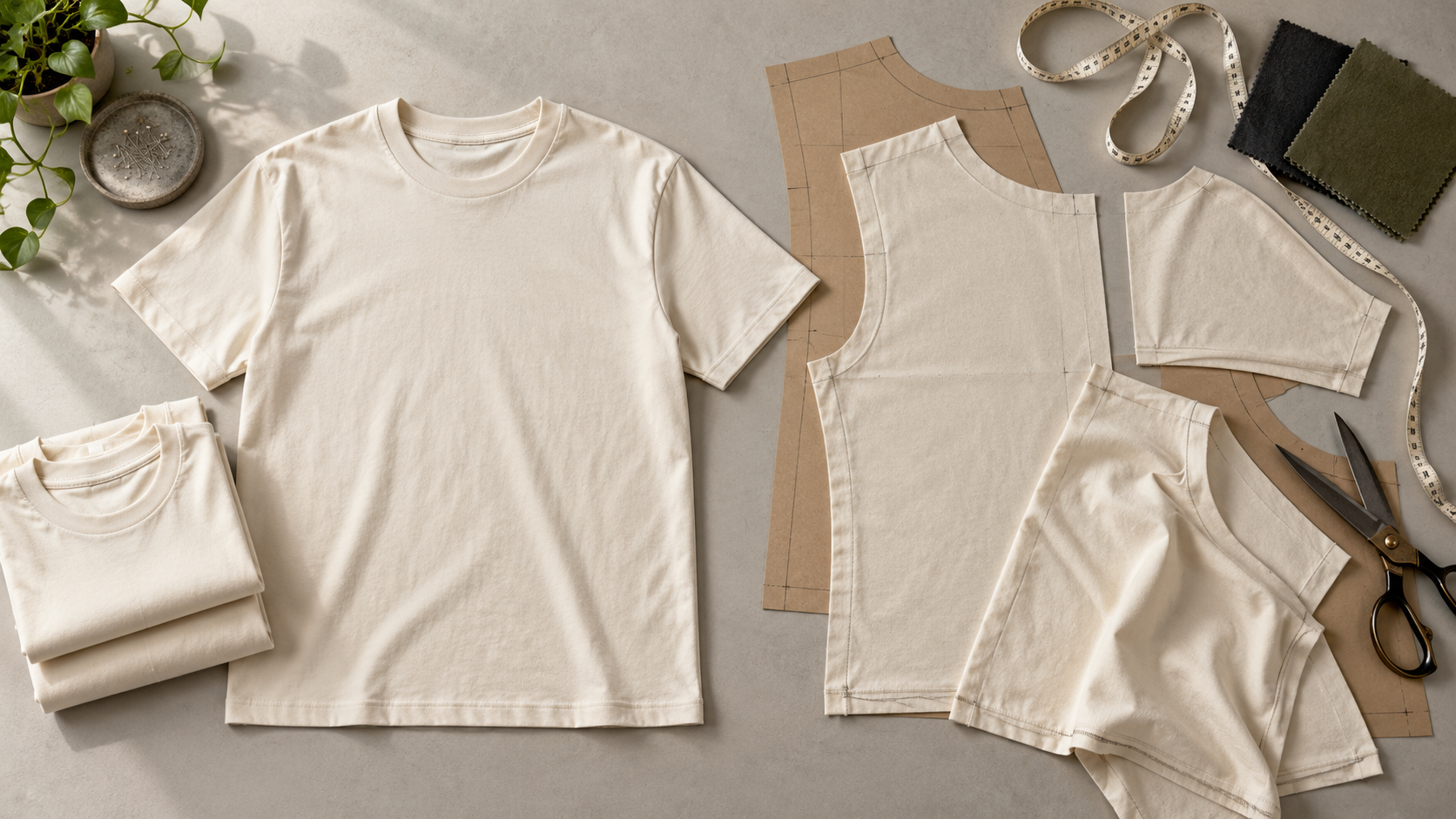
Choose blanks when an existing garment already meets your fit and fabric requirements and you mainly need branding. Choose custom cut-and-sew development when your product needs specific measurements, materials or construction that available blanks cannot provide. That is the starting point for the cut and sew vs blanks decision. Neither route automatically creates a better clothing brand. The right choice depends on what makes your product different and what you are ready to develop. For a streetwear label, that difference might be a graphic. It might also be the shape of the hood, the length of a T-shirt or the proportions of a matching set. Before requesting quotations, identify which of those details are essential.
What Is the Difference Between Cut and Sew and Blanks?
A blank is an existing undecorated garment that can be selected for printing, embroidery or other branding. Its underlying fit and construction are already established. In this guide, custom cut and sew means developing a garment to an agreed specification, with decisions about its pattern, fabric, fit and construction. This involves more product development than choosing an existing blank. There is an important terminology detail: “cut and sew” describes a production process, so it does not always mean a completely original pattern. For example, Printful uses cut-and-sew techniques for its catalog-based all-over-print products. Ask what you can actually change rather than relying on the service name alone.
When Should a Clothing Brand Choose Blanks?
Consider blanks when you can find an existing garment that already delivers the product experience you want. This route can suit a brand whose main creative difference is its artwork, message or community. You still need to select the garment carefully: the fabric, fit and decoration all contribute to the finished product. Available blank styles generally determine the underlying measurements and material options. Customization commonly focuses on printing, embroidery and branding applied to the existing garment. Before deciding, order samples of the actual blanks you are considering. Wear them, compare their measurements and test the intended decoration. Do not choose a garment only because its product photo looks close to your reference. A practical question: If you removed your logo, would you still be happy selling this garment? If the answer is yes, a blank may be a sensible starting point.
When Does Custom Cut-and-Sew Manufacturing Make More Sense?
Consider custom development when an essential part of your product cannot be achieved by decorating an existing garment. Examples might include:
- A hoodie with a specific relationship between chest width and body length.
- A T-shirt with a distinctive sleeve shape.
- Trousers with a particular rise, pocket layout or leg opening.
- A matching set developed around your own measurement specification.
Turn those requirements into a brief before asking for production. Instead of requesting “a premium oversized hoodie,” describe what the fit should do and which features are non-negotiable. Ask the manufacturer to identify the specifications that still require development. Custom development gives you more decisions to make. Be prepared to review materials, measurements and samples rather than expecting a reference image to settle every detail.
Is Private Label Clothing the Same as Custom Cut and Sew?
No. Private labeling does not, by itself, prove that the garment was developed from an original pattern. An existing garment can carry your branding. Apliiq, for example, offers private labeling on selected garments by replacing the manufacturer’s tag with a brand label. When speaking with a supplier, ask: “Will this product use an existing garment, an existing pattern with modifications, or a new pattern developed for our specification?” Then confirm the practical details:
- Which measurements can change?
- Which fabric choices are available?
- What development charges apply?
- What files and specifications will you receive?
- How will repeat orders be matched?
A clear explanation of the work is more useful than a broad label such as “fully custom.”
Which Route Costs Less?
Compare quotations for your actual product requirements. There is no universal price difference that applies to every blank and every custom garment. For a blank-based order, request the garment, decoration, labeling, packing and delivery costs. For custom development, also ask whether pattern work, samples, grading or other development charges are separate. Then compare three figures:
- The total amount needed before you can launch.
- The cost of each finished, delivered garment.
- The cost and conditions of a repeat order.
Avoid comparing a decorated blank with an undecorated custom garment. Make sure each quotation includes the same branding and packing requirements. A lower unit price can still require a larger total commitment. Judge the order against the quantity you reasonably expect to sell.
Which Option Is Better for a First Streetwear Drop?
Use the smallest development scope that still delivers your intended product. Consider two hypothetical brands. Brand A is launching an illustration-led T-shirt collection. It finds an existing shirt with the right shape, fabric and size range. Its next step could be testing the artwork on that blank and checking the finished result. Brand B is launching a hoodie built around a distinctive fit. The available blanks are consistently too long, and their hoods do not match the intended design. Custom development may be justified because the garment itself is central to the product. Neither brand needs to follow the other’s route. Write down your three most important product requirements. If an existing blank meets them, evaluate it seriously. If it does not, explain those gaps to a manufacturer before commissioning development.
Can You Use Blanks and Custom Garments in the Same Collection?
Yes, provided the finished collection feels consistent to your customers. For example, you could develop a signature hoodie while using a carefully selected blank for a supporting graphic T-shirt. Review the pieces together rather than approving them in isolation. Check whether their colors, fit descriptions, branding and perceived quality support the same brand identity. Also keep their reorder arrangements separate. Different products may have different availability, minimum quantities and timelines.
What Should You Check Before Approving Either Option?
Approve the finished garment, including its decoration and labels—not just an undecorated reference. For a blank-based product, record the supplier’s exact style, color and size references. For custom development, record the approved specification and sample version. In both cases, review:
- Fit and measurements.
- Fabric feel and appearance.
- Decoration size and placement.
- Labels and packaging.
- Appearance after the agreed care test.
- Any remaining changes before production.
Use our custom hoodie sample checklist when reviewing a hoodie before bulk approval.
What Should You Send a Manufacturer If You Are Unsure?
Send a short brief that separates requirements from preferences. Include your garment type, reference images, target fit, fabric preferences, artwork, quantities by color, size range and delivery destination. Then explain what existing products have failed to provide. For example: “We have tested two available hoodies. Their chest fit works, but we need a shorter body and a different hood shape. Please explain the development options and sampling requirements.” That gives the manufacturer a concrete problem to assess. Revoke Industries offers OEM and ODM apparel manufacturing, including production from buyer-supplied designs and development based on a brief. Its published services cover hoodies, T-shirts, tracksuits and other apparel.
Discuss Your Clothing Project With Revoke Industries
If you need garment development beyond the options you have already tested, share your brief with Revoke Industries in Sialkot, Pakistan. Identify the fit, fabric or construction details you want to achieve. Include your planned quantity, colors and destination so the team can assess the project and confirm the applicable requirements.
Contact Revoke Industries or email info@revokeindustries.com to discuss your design and sampling needs.
Add comment